Saturday Schmaterday…Who’s up for Some Poetry and Picture Books?

One week of poetry & rhyme down…4 to go!

*

*

I am tired but energized if that makes any sense! As I think I mentioned in one of the blogs, I am a night owl, HOOooo writes at night and sleeps during the day. It’s just how my brain functions best and with 4 kids, it is the only quiet time in the house. It works pretty well with our weekly schedule but weekends are difficult. I’m hoping I will find a few minutes today to actually read some picture books and do some of the writing prompts as I’ve been too busy writing future lessons and posting the daily blog posts.  I’ve thoroughly enjoyed everyone’s comments and I wish I could reply to them all. Just know that I am reading every one of them and it warms my heart to hear that you are enjoying this as much as I am. I also appreciate the humor that makes me giggle. The poem with An – gee was priceless and I have read it several times…Even Helen Frost like that one!


Don’t forget the Rhyming Party tomorrow on Facebook at noon.(Central Time) We will play some silly games and only be able to comment in rhyme. It is hilarious good fun! If you want to join the RhyPiBoMo Facebook Group, please request to join several hours before the party because I won’t be able to add you immediately before the event.
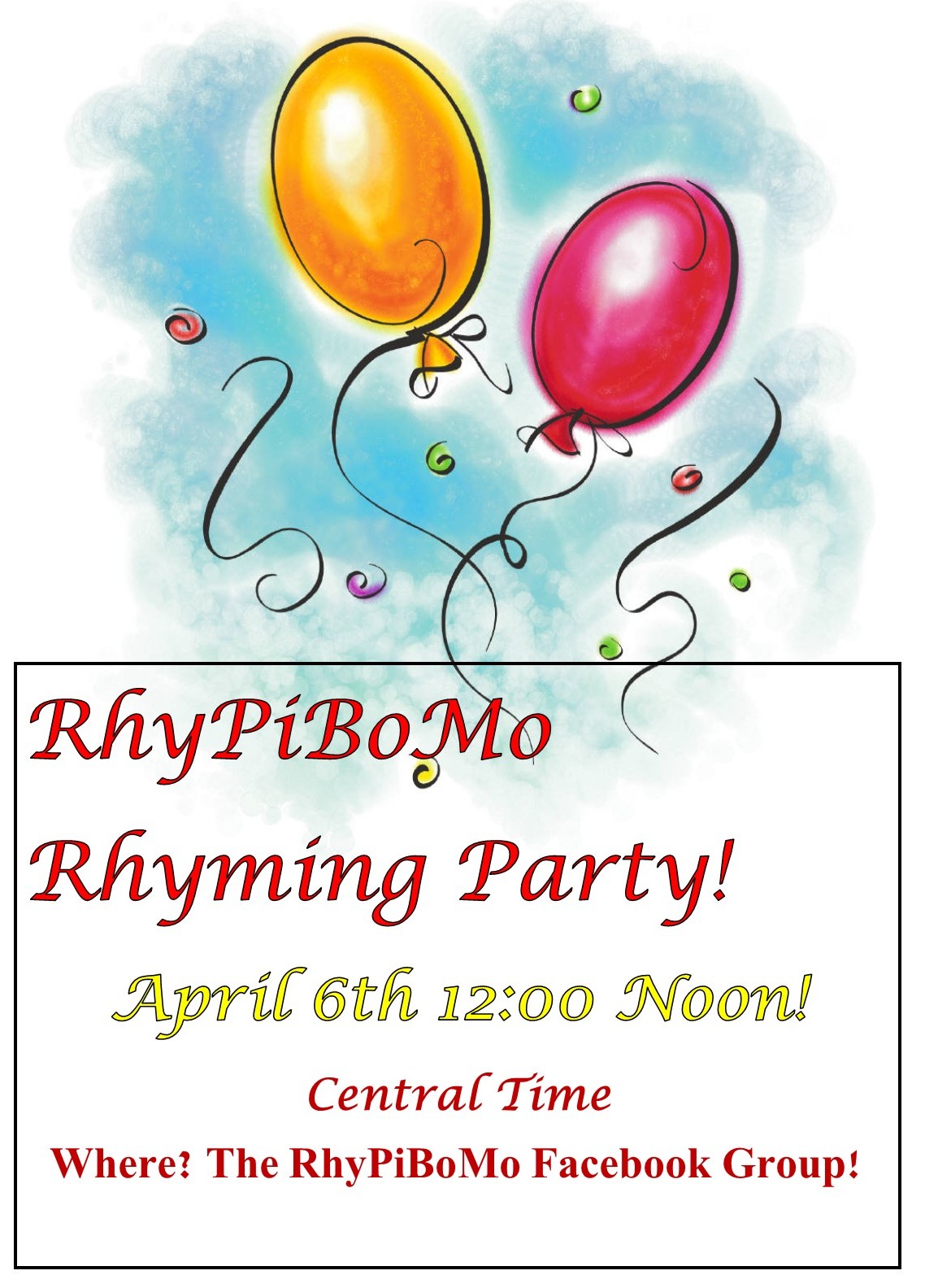
RhyPiBoMo Rhyming Party

Don’t forget to enter The Golden Quill Poetry Contest

Click the tab above that says “Golden Quill Poetry Contest” to enter. That is where you go to send your poem. There is no registration for this contest, just copy and paste your poem in the contact form and send it to me. There are quite a few rules as we are learning about poetry with all its rules, I didn’t want you  to think I was being soft on you! I have received several poems already. Please make sure you follow ALL the directions, especially leaving your first and last name as well as a contact email address or phone number so i can contact you if you are one of the winners.  Any poem that does not follow all the rules will be disqualified. AND…you may only enter one poem. Maybe next year we will have multiple categories but I needed to keep it simple this year. Good luck and may Willy S. be looking over your shoulder!  For contest details: https://angiekarcher.wordpress.com/rhypibomo-golden-quill-poetry-contest/

*

*

RhyPiBoMo Poetry Contest Scroll

*

*

Today’s guest blogger mentions in her post that she is “a writer who rhymes. No claim to being a poet.” There are many of us that can completely relate to that! I’m thrilled that she is here, not to defend herself, but to share her wisdom about writing rhyme…her work speaks for itself and needs no defending whatsoever!


So, without further ado, I’m honored to present today’s

Golden Quill Guest Blogger

Denise Fleming

*
         Rhypibomo Guest Blogger Badge      Denise Fleming 1

*

*

Crunch, munch, caterpillars lunch…

*

*
Growing up I chanted nursery rhymes. I listened to a lot of broadway show tunes, because my mom was active in local theatre and every now and then she would be in a musical. My sister and I would learn the lyrics and would sing along with Mom. My dad listened to jazz and the blues and we sang along to that. So my background is made up of song lyrics. Lots of near rhyme, single syllable rhyme and rhythm. I feel rhythm is a big part of a good picture book text. Picture books are theatre—are meant to be read aloud.

*

*

When I started writing and illustrating picture books, I had only taken one workshop. A great 10 day workshop with Uri Schulevitz, Writing with Pictures, which introduced me to how to create a complete picture book. I remember him saying don’t write in rhyme, there is too much bad rhyme out there, and don’t use a lot of color because it will cancel itself out and end up being another form of B&W. Well, no worry, I hadn’t planned on writing BAD rhyme and color was my thing, so that surely didn’t apply to me. My first book was In The Tall, Tall Grass, written in rhyme, packed with color. It did exceptionally well. So I merrily went on rhyming and using lots of color.

*

*

Then FB came along and all these blog posts were written and come to find out that I was doing BAD things like one syllable rhyme and near rhyme, and that I did not know a lot of the terms I was supposed to know. Good lord, I was setting a very bad example! Then Angie Karcher posted about RhyPiBoMo. And I signed up, because someone needed to defend me. I am a writer who rhymes. No claim to being a poet.

*

*

Some of my books are rhyming. Others are not because they just wouldn’t work. Time To Sleep started as a rhyming text, but I had too much info to impart. I would have had to force rhyme. Instead, I used a refrain, “winter is on its way,” to tie the story together.

*

*
In The Tall, Tall Grass is a rhyming chant. The reader is watching creatures all around going about their lives: “Crunch, munch caterpillars lunch / Dart, dip,hummingbirds sip.”

*

*

Denise Fleming 3

*

*

Barnyard Banter is rollicking verse. A goose is running around chasing a butterfly. Everybody is where they should be except goose: “Cows in the pasture, moo, moo, mom, moo / Roosters in the barnyard, cock a doodle doo.” Where Once There Was A Wood is about an area of land that has been leveled for a housing development: “Where once there was a wood, a meadow and a creek / Where once the red fox rested and closed his eyes to sleep.” All three books are written in simple rhyme, but each one has a particular rhythm to evoke a particular mood.

 *

*

Denise Fleming 2

*

*


It is hard to explain BAD RHYME to people. For some reason people seem to think if you are going to write for children you must rhyme. NO. They also think that if you have sentences that rhyme and you string them together with no real intent or purpose that works. NO. Nonsense rhyme. NO (leave that to those who know what they are doing).
If you have a manuscript written in rhyme, look at it honestly. Drop the rhyme, write it in prose—Does it make sense? Is it clearer? Were you forcing the rhyme?

*

*

My advice is to read a lot of poetry. There are some wonderful poets that write for children. Read collections. Get out those sticky notes and mark the poems you like. Analyze why you like those particular poets. Read adult poets. And when you read, read out loud. Read with expression. Enjoy yourself!

*

*
Bio:
Denise Fleming is the award-winning author and illustrator of many well known children’s books including In the Tall, Tall Grass and In the Small, Small Pond, which received a Caldecott Honor and her most recent book Underground.
As a young girl, Denise used to spend hours in her father’s workshop cutting, gluing, carving and building things. Today, she spends many hours in her own workshop studio, cutting, gluing and creating her picture books. Denise’s unique papermaking technique Is a labor-intensive process that involves hauling buckets of water, mixing and dying cotton fiber pulp. She then pours pulp through hand-cut stencils to form her bold, textured Illustrations. Denise’s love of language is apparent in her writing which combines rhythm, rhyme and lots of verbs. Denise Fleming’s books get kids laughing and loving reading.
Denise is a graduate of Kendall College of Art and Design in Michigan. Along with her husband and daughter, Denise lives in Ohio. Her books are a family effort as together they review words, pictures and ideas for new books. For more information about Denise Fleming and her books, visit her online at http://www.denisefleming.com.

*

*

UnderGround

Thank you Denise Fleming!

~~~~~~~~~~~~~~~~~~~~~~~~~~~~~~~~~~~~~~~~~~~~~~~~~~~~~~~~~~~~~~~~~~~~~~~~~~~~~~~~~~~~~~~~~~~~~~~~~~~~~~~~~~~~

*

RhyPiBoMo Daily Lesson: Saturday, April 5th
By Angie Karcher © 2014
Lesson 7

*

There are 3 basic genres of poetry: Lyrical, Narrative and Dramatic

*

Lyrical Voice

*
Lyrical Voice is the voice of the poet coming through in the written poem.
(write this down)


*

A lyrical poem expresses the emotions and feelings of a poet. It is used to express a personal how the poem views the world around him/her and of personal experiences. The poet puts him or herself in the poem. Lyrical voice is the most common voice used by poets.
This is where we get the word lyrics – the words of songs – this associates poetry with music. It is derived from a musical instrument called the lyre that was used to accompany the reading of this type of poem. The lyrical poem was set to music.
*

A Lyre is a small, stringed, harp-like instrument played mostly in ancient Egypt, Israel and Greece.
This can most often be identified by the use of the words I, me, my, mine, we, our, ours, and us
Interestingly, poetry has changed over the years in many ways but one noticeable difference from original poetry is that today poetry is mostly read silently. Years ago, poetry was sung or read aloud in poetry readings or plays. It was a social experience enjoyed by many writers and non-writers of the day. Of course, poetry readings are held today but are not nearly the social gatherings as they once were.

*

Sadly, a written poem can be compared to the written, musical score of a song. The joy is in hearing the notes played by instruments as there is joy in hearing the words said out loud. This allows for expressiveness, dramatic accents, pacing, and much more.
I had never thought about how our culture today is missing out on this art form of poetry…the oral sharing of a poem and the music of language.

*

*

Narrative Voice

*

*

Narrative Voice is the poet telling the story through the written word. (write this down)
The narrative voice tells a story. These stories may be humorous, sad, nonsensical, epic, or as simple as a nursery rhyme. The narrator is the storyteller. The story may be complete fantasy or it may be true but the poet never puts him or herself in the narrative poem.
A narrative poem typically uses a simple meter, such as a couplet (2 line stanza) or a quatrain. (4 line stanza)
They usually have a simple rhyme scheme…

*

A narrative poem typically uses a light meter for a humorous poem and a more structured, rigid meter for a serious poem.
Sometimes they are written in free verse.

*

Free verse poetry is written without rhyme and doesn’t follow any poetic form. (write this down)

*

It is full of emotion that is expressed in alliteration, consonance, internal rhyme and/or repetition. There are really no rules but some poets create their own rules.

*

An example:
This is one of my all-time favorite poems so I had to post it!

*

*

Casey at the Bat by Ernest Lawrence

*
The outlook wasn’t brilliant for the Mudville Nine that day;
The score stood four to two, with but one inning more to play,
And then when Cooney died at first, and Barrows did the same,
A sickly silence fell upon the patrons of the game.

*

A straggling few got up to go in deep despair. The rest
Clung to that hope which springs eternal in the human breast;
They thought, if only Casey could get but a whack at that –
They’d put up even money, now, with Casey at the bat.

*

But Flynn preceded Casey, as did also Jimmy Blake,
And the former was a pudding and the latter was a fake;
So upon that stricken multitude grim melancholy sat,
For there seemed but little chance of Casey’s getting to the bat.

*

But Flynn let drive a single, to the wonderment of all,
And Blake, the much despised, tore the cover off the ball;
And when the dust had lifted, and the men saw what had occurred,
There was Jimmy safe at second and Flynn a-hugging third.

*

Then from 5,000 throats and more there rose a lusty yell;
It rumbled through the valley, it rattled in the dell;
It knocked upon the mountain and recoiled upon the flat,
For Casey, mighty Casey, was advancing to the bat.

*

There was ease in Casey’s manner as he stepped into his place;
There was pride in Casey’s bearing and a smile on Casey’s face.
And when, responding to the cheers, he lightly doffed his hat,
No stranger in the crowd could doubt ’twas Casey at the bat.

*

Ten thousand eyes were on him as he rubbed his hands with dirt;
Five thousand tongues applauded when he wiped them on his shirt.
Then while the writhing pitcher ground the ball into his hip,
Defiance gleamed in Casey’s eye, a sneer curled Casey’s lip.

*

And now the leather-covered sphere came hurtling through the air,
And Casey stood a-watching it in haughty grandeur there.
Close by the sturdy batsman the ball unheeded sped-
“That ain’t my style,” said Casey. “Strike one,” the umpire said.

*

From the benches, black with people, there went up a muffled roar,
Like the beating of the storm-waves on a stern and distant shore.
“Kill him! Kill the umpire!” shouted someone on the stand;
And it’s likely they’d a-killed him had not Casey raised his hand.

*

With a smile of Christian charity great Casey’s visage shone;
He stilled the rising tumult; he bade the game go on;
He signaled to the pitcher, and once more the spheroid flew;
But Casey still ignored it, and the umpire said, “Strike two.”

*

“Fraud!” cried the maddened thousands, and echo answered fraud;
But one scornful look from Casey and the audience was awed.
They saw his face grow stern and cold, they saw his muscles strain,
And they knew that Casey wouldn’t let that ball go by again.

*

The sneer is gone from Casey’s lip, his teeth are clenched in hate;
He pounds with cruel violence his bat upon the plate.
And now the pitcher holds the ball, and now he lets it go,
And now the air is shattered by the force of Casey’s blow.

*

Oh, somewhere in this favored land the sun is shining bright;
The band is playing somewhere, and somewhere hearts are light,
And somewhere men are laughing, and somewhere children shout;
But there is no joy in Mudville — mighty Casey has struck out.

*

*

Hey Diddle Diddle

*

Hey diddle diddle,
The cat and the fiddle,
The cow jumped over the moon.
The little dog laughed,
To see such sport,
And the dish ran away with the spoon

*

Old Mother Hubbard
http://www.rhymes.org.uk/old_mother_hubbard.htm

*

Jabberwocky by Lewis Carroll
http://www.jabberwocky.com/carroll/jabber/jabberwocky.html

*

Sarah Cynthia Sylvia Stout Would Not Take the Garage Out by Shel Silverstein

*

Jimmy Jet and his TV Set by Shel Silverstein
http://shelsilversteinpoems.wordpress.com/2012/01/22/jimmy-jet-and-his-tv-set/

*

*

Dramatic Voice

*

Dramatic Voice has several forms…Apostrophe, The Mask and Conversation

*

*
Apostrophe is a dramatic voice where the poet talks to inanimate objects that cannot answer.

*

Who has the better right
To smell the first summer rose,
Bee – you or I?

*

For example:
O Captain! My Captain! by Walt Whitman
http://www.famousliteraryworks.com/whitman_o_captain_my_captain.htm

*
The Mask is when a poet pretends to be someone else and takes on their thoughts, their words, their life…This can be another person or an object.

*

For example:
Message From a Caterpillar by Lilian Moore
Don’t shake this bough.
Don’t try to wake me now.
In this cocoon I’ve work to do.
Inside this silk I’m changing things.
I’m worm-like now but in this dark I’m growing wings.

*

How to write a mask poem
http://ettcweb.lr.k12.nj.us/forms/mask.htm

*

*
Conversation is when two different voices talk back and forth to each other.
Often conversation poems are written in a way that you have to guess who is talking.
A more recent name for this seems to be a dialogue poem.

*

Sock and Shoe Speak
“Oh no!” said my sock,
“What a smell!
You need a bath, Mr. Shoe.
I can tell!”

*

“I’m leather,” said Shoe.
“I don’t smell.
Your dryer sheet stinks!
I’m unwell!”

*

“I need a clothespin,”
said the sock.
“It’s the only way
we will walk.”

*

Shoe laughed and he smiled
“With no nose,
Sock, what will you do?
Hold your toes?”

*

I tugged on my shoe
“They’re so tight!
Would you both please
stop with this fight!”

*

*
For example:

There is a fourth genre of poetry called The Didactic form. A Didactic poem teaches a lesson or involves a moral dilemma. It is also considered instructional poetry meant to teach lessons on science, math, philosophy, etc.

*

Examples of Didactic poems:
http://www.thehypertexts.com/Best%20Didactic%20Poems.htm

*
Another Resource:
Poems for Kids
http://poemsforchildren.org/index.htm

*

Writing Prompt: Choose a genre of poetry and write a poem that fits into the rules for that genre.

*

*

Okay, now do everything else on the pledge for today and don’t forget to comment on today’s blog post!

RhyPiBoMo Pledge

RhyPiBoMo Pledge

Please comment ONLY ONE TIME below for a chance to win today’s prize!
Prizes will be drawn by Random.com next Sunday for the previous week.
To be eligible for a prize you must be a registered participant and
comment after each days lessons.

It’s…Fasten Your Seat Belt Friday!

It’s Fasten Your Seat Belt Friday!

*

*

What does that mean? Well, we are 6 days in and it’s not going to get any easier!  Poetry is not for the weak of heart!

*

I’m sure, at this point, some of you are reconsidering your choice to be here and that’s okay. These lessons are time consuming and involved if you are doing absolutely everything offered here. I don’t expect that you are, nor should you expect that of yourself. You should make it what works for you.

*

I felt your same frustration weeks ago when I began writing these lessons. I promise they are as tight as I could get them and still give a full explanation of the concepts. We won’t even talk about all the exceptions to the rules! Think of RhyPiBoMo as a buffet…take what you like, try a few things you’ve never tasted before and come back for the dessert, which I think will be the picture book part of this event.  I have no expectations of anyone but myself and I’m thrilled to have so many writers attend the feast. Please remember…it’s not polite to say you don’t like something…try it and spit it out quietly on your plate if it doesn’t taste good.

*

The daily pledge requirements are not that time consuming; read the blog posts, comment, write a poem, read a rhyming picture book. The rest offered here is a bonus! You can save it, look at it later, catch up when you can, or ignore it completely…make it work for you and your journey.

*

If you need to quietly bow out now, we all understand. You may just quit commenting on the blog and consider yourself removed from this process.  I hope you can find the time to join us next year!

*

The only one who has any complete commitment to this event is me as I decided last November to dedicate myself to learning everything I can about poetry and writing rhyme. I decided that if I was going to do all this research and spend all this time reading and studying poetry/rhyme, that I should invite some writing friends to join me…it snowballed from there. And RhyPiBoMo was born.

*

I hope that you can take what works for you from these lessons and apply it to your writing.

I hope that you are learning something that you didn’t know before you got here.

I hope that you are writing poetry.

I hope that you are reading picture books.

I hope that you are meeting new writing friends in our Facebook Group.

I hope that you are being introduced to amazing guest bloggers that will inspire you.

I hope that you are working on a rhyming picture book  manuscript.

I hope that you have joined or are in a rhyming critique group.

I hope that even if you step away from this event you will continue to learn and grow with your writing.

*

I hope you stay.

*

*

RhyPiBoMo Mission Statement:
My goal is to guide those aspiring to write rhyme and poetry through the process of learning the craft and offering resources, lessons, writing prompts and the wisdom of experienced folks in the business to improve the reputation and quality of rhyme and poetry for children.

*

*

*

Today’s guest blogger is a friend I met while taking The Hero’s Art Journey Course with Mira Reisberg and Maya Gonzalaz at the Children’s Book Academy. She is a writer, a photographer, an educator, an artist and an editor…and very talented in all her endeavors. She is going to cover something very important about poetry and rhyming picture books, especially if you want teachers to use your books in the classroom.

*

*

So, without further ado, I’m honored to present today’s

Golden Quill Guest Blogger

Mary A Livingston

              Rhypibomo Guest Blogger Badge     Mary A Livingston 1

*

*

Common Core State Standards and Rhyming Picture Books

by Mary A Livingston

*

*

Recently, I’ve been working with a team of educators to make some select locally published picture books Common Core State Standards (CCSS) ready. One of the eight titles we’re creating CCSS Modules for is a rhyming picture book.
The rhyming picture book CCSS Module has a little more meat when compared to its prose counterparts.

*
At first I focused on the K-5 standards when looking for rhyme applications, but two members of our team are middle school teachers, both use rhyming picture books to reacquaint their older students to meter, rhythm, and rhyme prior to working in their grade level texts. One stated, “Using picture books is a fun, non-intimidating way to introduce literary concepts to my older students.”

*

Common Core State Standards (http://www.corestandards.org) specifically referencing rhyme:

*

English Language Arts Standards » Reading: Foundational Skills » Kindergarten
Phonological Awareness:
CCSS.ELA-Literacy.RF.K.2.a
Recognize and produce rhyming words.

*

English Language Arts Standards » Reading: Literature » Grade 2
Craft and Structure:
CCSS.ELA-Literacy.RL.2.4
Describe how words and phrases (e.g., regular beats, alliteration, rhymes, repeated lines) supply rhythm and meaning in a story, poem, or song.

*

English Language Arts Standards » Reading: Literature » Grade 7
Craft and Structure:
CCSS.ELA-Literacy.RL.7.4
Determine the meaning of words and phrases as they are used in a text, including figurative and connotative meanings; analyze the impact of rhymes and other repetitions of sounds (e.g., alliteration) on a specific verse or stanza of a poem or section of a story or drama.

*

Rhyming picture books also add benefit in categories referencing verse, rhythm, and meter:
English Language Arts Standards » Reading: Literature » Grade 4
Craft and Structure:
CCSS.ELA-Literacy.RL.4.5
Explain major differences between poems, drama, and prose, and refer to the structural elements of poems (e.g., verse, rhythm, meter) and drama (e.g., casts of characters, settings, descriptions, dialogue, stage directions) when writing or speaking about a text.

*

*

A positive aspects of CCSS is the integration of literature into the curriculum, both fiction and nonfiction. We all know wonderful teachers who’ve already adapted their teaching style to include literature in the classroom. The integration of outside literature as part of a core curriculum now requires documentation to substantiate how the literature addresses CCSS. Many teachers I’ve spoken with have expressed concern about additional paperwork related to citation requirements of CCSS. Unless the teacher uses only canned curriculum ready materials, CCSS means a lot of additional paperwork for the teacher when citing exactly how the book and supported materials fit the standard. The canned curriculum may be limiting and not able to address local needs. By Implementing Common Core Ready Modules provides teacher, parents, and librarians with documentation and guidelines to support CCSS when using a title in the classroom.

*

*

Some publishers are adding CCSS content specifically for their published titles, thus adding market value and aiding teachers who wish to integrate those titles into the classroom.

*

*

I encourage picture book authors to be aware of CCSS. The full text of Common Core State Standards is at http://www.corestandards.org. Some states have added modified components. For specific state variations, use the search term: state name common core. If your rhyming picture book is CCSS ready, it increases market value and helps parents, teachers and librarians make the common core connection.

*

*

More resources on Common Core:
Common Core State Standards Initiative – http://www.corestandards.org
Cut to the Core – http://www.scoop.it/t/cutothecore
Common Core Toolkit (NY) – http://www.engageny.org/resource/common-core-toolkit
Common Core State Standards (CA) – http://www.cde.ca.gov/re/cc/
Children’s Book Academy, the site search “common core” returns several articles- http://www.childrensbookacademy.com

*

*

Mary A Livingston 2

*

*

Bio:
A Gelett Burgess Children’s Book Award recipient and California Federation of Chaparral Poets honoree, Mary, grew up in the forested communities of Humboldt and Trinity Counties of northern California. She attended Shasta College, Humboldt State University, and Loyola University. She has worked in photography, education, publishing, and liturgical design. Her career in children’s literature focuses on nature and environmental education. Fall 2014, she will be teaching a Children’s Book Academy course Using InDesign for Picture Book Dummies and e-Books.

*

Website: http://www.maryalivingston.com
Blog: http://www.backdoorartist.com
Blogs every third Friday: http://www.childrensbookacademy.com/blogettes.html
Facebook: http://www.facebook.com/maryalivingston.backdoorartist
Twitter: @BackdoorArtist
LinkedIn: http://www.linkedin.com/pub/mary-a-livingston/87/22/265

*

Mary A Livingston 3

Thank you Mary A Livingston!


~~~~~~~~~~~~~~~~~~~~~~~~~~~~~~~~~~~~~~~~~~~~~~~~~~~~~~~~~~~~~~~~~~~~~~~~~~~~~~~~~~~~~~~~~~~~~

RhyPiBoMo Daily Lesson: Friday April 4th

By Angie Karcher © 2014

Lesson 6

*


Sestina

*

*
A Sestina is a French form of poetry believed to have been invented by Arnaut Daniel, a troubadour from France.
A troubadour was a composer and performer that mainly wrote songs about chivalry and courtly love. There were troubadour schools that emerged in the early 12th century in England, France, Italy and other European countries.
I want to be a troubadour! It sounds very romantic. Technically, I would be called a trobairitz as a female performer. I like the word troubadour better…

*

*

troubadaur*

*

As we are learning to follow rules of poetry, I thought it would be interesting to try our luck at writing some poetry that doesn’t rhyme but has crazy rules about the ending words of each line.

*

End word – the last word in the line of the poem. (write this down)

*

*


A sestina is traditional form of poetry
In a sestina there are repeating end words in VERY specific patterns.
The sestina repeats words, not sounds.
Sestinas do not rhyme
You choose 6 words that will be repeated throughout the entire poem at the end of each line.
Usually all the lines have the same number of syllables.

There are Six stanzas with six lines each. Sestet – a stanza with 6 lines. (write this down)

*
Other forms similar to a sestina are a villanelle and a pantoum. We will not talk about these but you might want to research them on your own.

*

I’m sure there are reasons why the words are placed in this certain order and these decisions were made hundreds of years ago by some very serious poets.
That being said, I don’t know why the words must be in this order so…we will just follow the rules.

*

Let’s have fun with this! Think of it as a puzzle that you are trying to work…

*

*

Here…is the pattern of end words.
This is a technique known as “lexical repetition.”
You don’t have to write that down! LOL

*

*
Here is the order of the end words for each stanza:
Stanza 1: ABCDEF
Stanza 2: FAEBDC
Stanza 3: CFDABE
Stanza 4: ECBFAD
Stanza 5: DEACFB
Stanza 6: BDFECA

*

*

This is a different graphic to help explain the same thing, the pattern of the end words.

*

*

sestina image 2

http://en.wikipedia.org/wiki/Sestina

*

*

*

Rules:

*
1)Choose 6 words
Some people choose related words and some pick the first 6 words that pop into their head.
2)Follow the rules for placement of those 6 words at the end of each line.

*

After I choose my 6 words, I list them in the order according to the rules, where they will remain as the end word for each line. After all the words are in place I go back and begin to write each line, knowing that the word listed must be the end word. Seeing them all sitting there, top to bottom, helps me to focus on the story. It gives me somewhere to go and helps me to connect the words.

*

To complete the sestina, there is one more stanza after the 6 stanzas called an envoi. I will address this after we have learned how to write the main part of the sestina…

*

I wrote this sestina after attending an SCBWI workshop in Brown County, Indiana many years ago. Helen Frost gave a talk on her poetry techniques.
I was hooked but haven’t looked at this in years. It was challenging yet fun to try to make it work with ALL the rules and have it make sense as a story.

*

I’m not saying it works…just that I tried to make it work! LOL
We will go through this poem step-by-step as an example of how to organize the end words. Hold on tight…here we go!

*

STEP-BY-STEP EXAMPLE:

*

WHITE PICKET FENCE

My 6 end words

*
A fence
B life
C house
D worked
E ocean
F rust

*These words are assigned to each letter. Where that letter goes in the pattern, that word must go!

*

Here are the end word rules again.  Refer back often to these rules until you have your words in the right order.

*
Stanza 1: ABCDEF
Stanza 2: FAEBDC
Stanza 3: CFDABE
Stanza 4: ECBFAD
Stanza 5: DEACFB
Stanza 6: BDFECA

*

Stanza 1ABCDEF

*
Now I start writing the first line…

*

A Paint was silently peeling on the white picket fence.
B It stood, weakly, wearing gray with white patches, just like Megs life,
C chipped and sad. Her parents rented out her grandmother’s beach house,
D knowing that people who took vacations would come. It worked.
E Everyone, but Meg, loved the relaxing breeze of the ocean.
F The salt water made everything rust.

*

The next stanza must follow this pattern with the end words.
Stanza 2 FAEBDC

*
F The screen door, the hammock chains, the car fender; rusted.
A The sandy yard was surrounded by this rickety old fence.
E Leaning. Falling. Sad. Except for the sturdy gate to the ocean.
B The fence needed paint. So did Meg’s life.
D Chaos and joy. Madness and Glee. It worked,
C Dysfunctional and loud; her life. She wanted a pristine white picket fence at her house.

*

The next stanza must follow this pattern with the end words.
Stanza 3 CFDABE

*
C She ached to abandon this tired house
F for something better. Leave behind the rust.
D Meg dodged their storms like a ship lost in the ocean
A and it’s permanent harm. Nothing worked
B here. Her parents needed the fence
E between them. They fought everyday of her life.

*
The next stanza must follow this pattern with the end words.
Stanza 4 ECBFAD

*
E Today she felt an ocean
C of emotions. In the newly-rented, beach house
B there was a family with a great life.
F Somehow, they didn’t notice the rust.
A They never saw an old, worn out picket fence.
D To tourists, it was charming and quaint. It worked.

*

The next stanza must follow this pattern with the end words.
Stanza 5 DEACFB

*
D Meg heard the car door slam, as her dad left for work.
E She felt waves of relief crashing in her ocean.
A She saw chips of old paint falling from the old fence.
C The gate stood up strong, facing the house.
F Strangely, it was the only part of the fence that fought the rust.
B Meg imagined running through the gate to find new life.

*

The next stanza must follow this pattern with the end words.
Stanza 6 BDFECA

*

B A coat of paint would give the fence new life.
D Would it be worth all that work?
F The paint would only hide the peeling and the rust.
E It wouldn’t take long for the ocean’s
C wind and sun to attack once again. Soon Meg’s house
A will look the same as the fence.

*

My envoi:
BE

She knew her life would wash away like the waves on the ocean.

DC

Nothing worked here; the anger and dysfunction were locked in the beach house.

FA

The rust, might free her from what kept her here, inside this white picket fence.

*

I just realized that I forgot the rule about each line having the same syllables…that gives me something to work on!

*

Sestina image 1

This is another chart showing the order of the end words. 

*

*

Now, we will tackle the envoi

*

Envoi – The envoi is the last stanza consisting of 3 lines using the same previous 6 end words one or more times.
The traditional order of the end words in the three lines is BE, DC, FA
The first word used is somewhere within the line, the second word is the end word. (write this down)

*

Rules for the envoi:
BE
DC
FA

*

So that puts my words in this order of usage:
life, ocean
worked, house
rust, fence

*

The second word of each pair is the end word.
BE life, ocean
DC worked, house
FA rust, fence

*

*
Thus…my envoi:
BE She knew her life would wash away like the waves of the ocean.
DC Nothing worked here; the anger and dysfunction were locked in the beach house.
FA The rust might free her from what kept her here, inside this cagey fence.

*

This is very dramatic for me and I have never written anything this emotional before or since writing this poem. Those 6 words forced me to dig deep to find emotions and to be clever with their usage. Using a varied form of a chosen word is permitted.
To give this poem something unique, or my special touch, I added a rule. Look back at the first stanza, notice the first letter of each line going down.
Each line begins with the letters in the word picket, spelling downward.
The title of the poem is White Picket Fence.
It’s something I did consciously but not without a great deal of time and effort.
Once you are committed to following rules, it becomes very freeing in a strange way. The limit to the word usage really forces the writer to be clever and creative and thrifty with the words when telling the story. You know what the last word is…let the story take you there in each line.

*

You must read Helen Frost’s books but particularly Keesha’s House to see

how amazingly good she is at writing poetic forms.

Keeshas house

http://www.amazon.com/s/?ie=UTF8&keywords=keesha+house&tag=mh0b-20&index=stripbooks&hvadid=1696691885&ref=pd_sl_8hmlmea59f_ee

*

Keesha’s House is written in strict poetic forms and there are wonderful sestinas throughout. Another favorite of mine is The Braid. Helen has invented her own poetic form for this book. The words are literally braided throughout each poem!

*

More examples:
Here is a sestina titled Sestina by Dante Alighieri
http://famouspoetsandpoems.com/poets/dante_alighieri/poems/44

*

Here is another one titled Sestina by Elizabeth Bishop
http://www.poemhunter.com/poem/sestina/

*

*
This is a diagram that explains the pattern for the changing end word rules. Honestly, this confuses me as I am fine to just plug in the assigned word at the end of each line and then come back and write the line. I added this image because we all learn in different ways so maybe it will be helpful to you.

*

*

sestina image 3

*

*

Writing Prompt: Now it’s your turn! Write a Sestina
Choose 6 words and fill in the blanks.

List your 6 words
A _______________
B _______________
C _______________
D _______________
E _______________
F _______________

*

These are your 6 end words. Now, follow the rules and see what happens.
Who knows where this will take you! Good Luck!

*

Why learn about writing a Sestina? They don’t even rhyme…
Because…it will help us understand about traditional poetry structure, methods and patterns. It will help us become more well-rounded writers in general and help us to learn other patterns and rules in poetry as we go along.

~~~~~~~~~~~~~~~~~~~~~~~~~~~~~~~~~~~~~~~~~~~~~~~~~~~~~~~~~~~~~~~~~~~~~~~~~~~~~~~~~~~~~~~~~~~~~~~~~~~~~~~~

Sonnet

*

*

The sonnet originated in Italy. In Italian, sonnet means “little bird or little song.”
It is the most flexible and common poem of fixed poems
There are 3 common types of sonnets written; Petrarchan, Shakespearean, and Spenserian.
In honor of Willy S. we will learn the Shakespearean form which is of course the English sonnet.

*

*

Rules for a Sonnet:
It has 14 lines
Written in iambic-pentameter
The first 8 lines are called the Octave.
A problem or the question is set up in these 8 lines.
The 9th line is called the volta.
It is the line that changes the shift from problem to solution.
The last 6 lines are called the Sestet. A resolution or response to the octave occurs here.

*

There are other rules that are more specific to the content and what each stanza is supposed to say. As this is all new to many of us, I will not go into more detail about that but please venture on if you are interested.

*

Iambic Pentameter (write this down)

An unstressed/stressed foot is known as an iamb. Remember…da-DUM.
Penta means 5 feet
It has 10 syllables.
So a line of poetry written in pentameter has 5 feet, or 5 sets of stressed and unstressed syllables da-DUM, da-DUM, da-DUM, da-DUM, da-DUM

*

For example:
if we | can see | the sun | be-hind | the clouds
da DUM | da DUM | da DUM | da DUM | da DUM

*

Often, in Shakespearean plays high class characters speak in iambic pentameter; lower class characters speak in prose. (I thought this was very interesting.)

*

*

For example:
A Shakespearean sonnet from Romeo and Juliet
Now old desire doth in his death-bed lie,
And young affection gapes to be his heir;
That fair for which love groan’d for and would die,
With tender Juliet match’d, is now not fair.
Now Romeo is belov’d and loves again,
Alike bewitched by the charm of looks,
But to his foe suppos’d he must complain,
And she steals love’s sweet bait from fearful hooks:
Being held a foe, he may not have access
To breathe such vows as lovers us’d to swear;
And she as much in love, her means much less
To meet her new-beloved anywhere:
But passion lends them power, time to meet,
Temper extremity with extreme sweet.

*

Writing exercise: See if you can identify the iambs, the pentas, the rhyme scheme, the octave, the volta and the sestet. This is our first quiz! Ha…you didn’t know there would be quizzes did you? Just kidding but try it anyway!

*
Let’s explore Stanzas in more detail.
Stanzas have special names based upon the number of lines. (write this down)

*
2 lines – Couplet
3 lines – Tercet
4 lines – Quatrain
5 lines – Quintet
6 lines – Sestet
7 lines – Septet
8 lines – Octave
9 lines – Nine-line stanza
10 line – Ten-line stanza etc…
Longer stanzas of poetry have a variety of couplets, tercets and quatrains.
These 3 are called the “Building Blocks” of poetry!

*
Rhyme Scheme
The rhyme scheme for a Shakespearean sonnet is:
A-B-A-B-C-D-C-D-E-F-E-F-G-G

*
The end words rhyme in this pattern. I think it helps to look at it in a vertical way to understand that each line must follow these rules for rhyming end words.

*

For example:
A Shell
B Alone
A Dwell
B Stone
C Stroll
D Eve
C Knoll
D Weave
E Breeze
F Drops
E Tease
F Stops
G Find
G Mind

*

*
My attempt at a sonnet:

*

           IN SEARCH OF SOLACE
1)I search with eyes intent to find a shell.
2)The clouds roll in and leave us all alone.
3)My thoughts retreat from where they often dwell.
4)No shells today; one lost and lonely stone.
5)I slowly roam the beach; my nightly stroll.
6)In search of what is lost this bronzing eve.
7)The waving grass blows gently on the knoll.
8)The beauty and the sadness start to weave.
9)Then suddenly a brisk and violent breeze,
10)Just one, then two, then many rainy drops.
11)The lightning strike tonight is not a tease.
12)I rush back; causing searching now to stop.
13)And when you stop the search is when you find.
14)A shell and solace; smiling peace of mind.

*

This needs lots of work as it is my original draft, but it was fun to keep all the rules going. Again, as when I write sestinas, I plugged in my rhyming end words first. I ended up changing one word…I changed well to dwell. This seems to help me immediately focus on a possible connection between the words and helps begin the story.

*

Now it’s your turn!

Writing Prompt: Write an English Sonnet, Shakespearean Style!
May Willy S. be ever at your side!

*

*

I had no idea that iambic-pentameter is something that I am very comfortable with…Over the years I’ve learned to play the clarinet, saxophone and piano. I am certain that this musical background helps me immensely with meter and rhythm.  This just happens to be one poetic form that I enjoy. I hope you find one that you enjoy too!

*

                                                        Happy iams and pentas to you,

                                                                                          ~Angie

*

*

Resources:
http://iambicpentameter.net/
http://www.sonnetwriters.com/how-to-write-a-sonnet/
http://www.dummies.com/how-to/content/writing-a-sonnet.html
http://www.sonnets.org/basicforms.htm

*

*

Okay, now do everything else on the pledge for today and don’t forget to comment on today’s blog post!

RhyPiBoMo Pledge

RhyPiBoMo Pledge
Please comment ONLY ONE TIME below for a chance to win today’s prize!
Prizes will be drawn by Random.com next Sunday for the previous week.
To be eligible for a prize you must be a registered participant and
comment after each days lessons.

Thirsty for Rhyme Thursday!

RhyPiBoMo is not canceled! I am the April Fool…

*

Where do I start?

*

Last night in the midst of a near panic attack because my blog post disappeared from my computer screen, (I’ll tell you about that in a sec) someone messaged me looking for the RhyPiBoMo Facebook page…they had been commenting on the Facebook EVENT page instead. I noticed several others had done the same thing but there were very few people checking those posts. SO…I decided to delete the EVENT page to eliminate confusion. The start date had passed so it didn’t occur to me that Facebook would send helpful emails notifying people that RhyPiBoMo had been cancelled. So much for making things less complicated!

*

It is not a crisis of magnificent proportions but it was frustrating. I think everyone is still here…LOL Thanks for your patience!

*

My earlier crisis was when I had 3/4 of the blog posted in the website and decided to go eat dinner. When I returned, the blog contents had disappeared completely. It’s a long story and technically ludicrous but…it was all still there…I just couldn’t see it! I hate cookies!

*

I did manage with Google and WordPress support to find the ghost-like blog and continue posting on a different browser.

*

I had a glass of wine with my whine after posting last night! LOL  = )

*

*

Today someone asked a great question about contemporary cinquains and how they differ from traditional cinquains.  It seems that a line was left out that explains it. Thanks for catching that! It’s complete now so you can look back and check out the differences. It’s actually pretty cool, and challenging!

*

*

Thanks to Vivian Kirkfield for helping gather a list of the picture books we are reading this week. She is compiling a list from a Facebook post. Please add the title and author’s first and last name so we can add them to a master of list…I wonder how many PBs we will read this month?

*

*

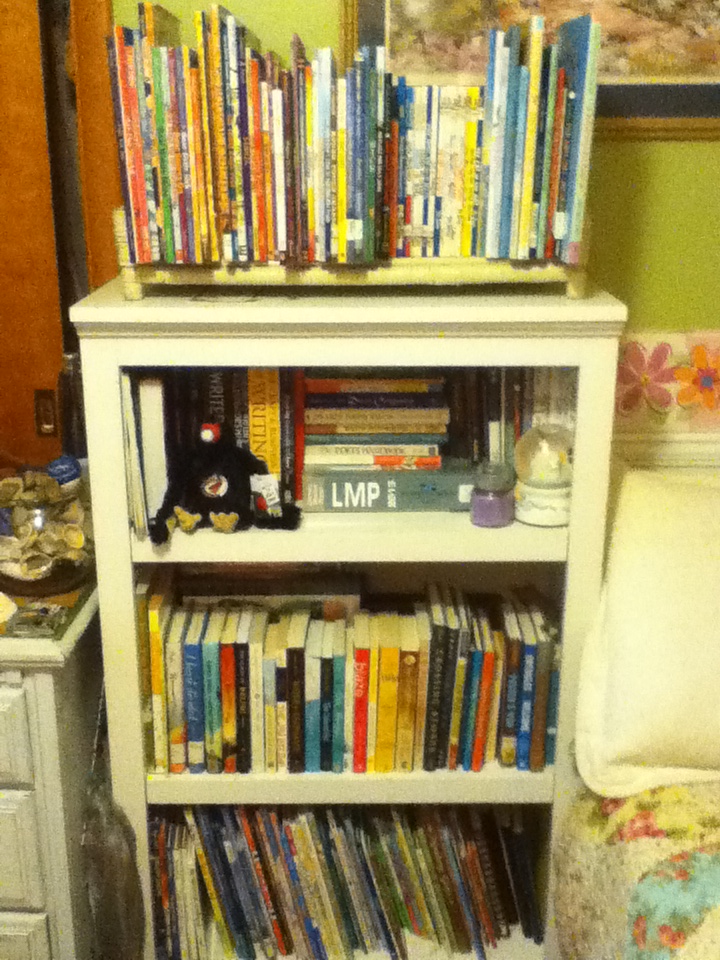
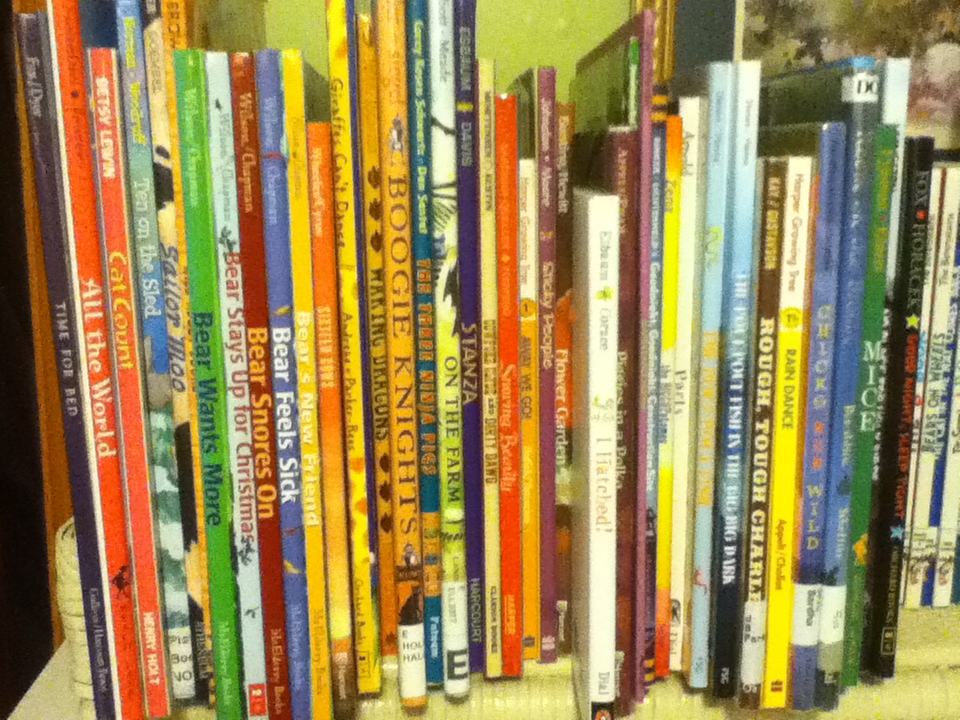
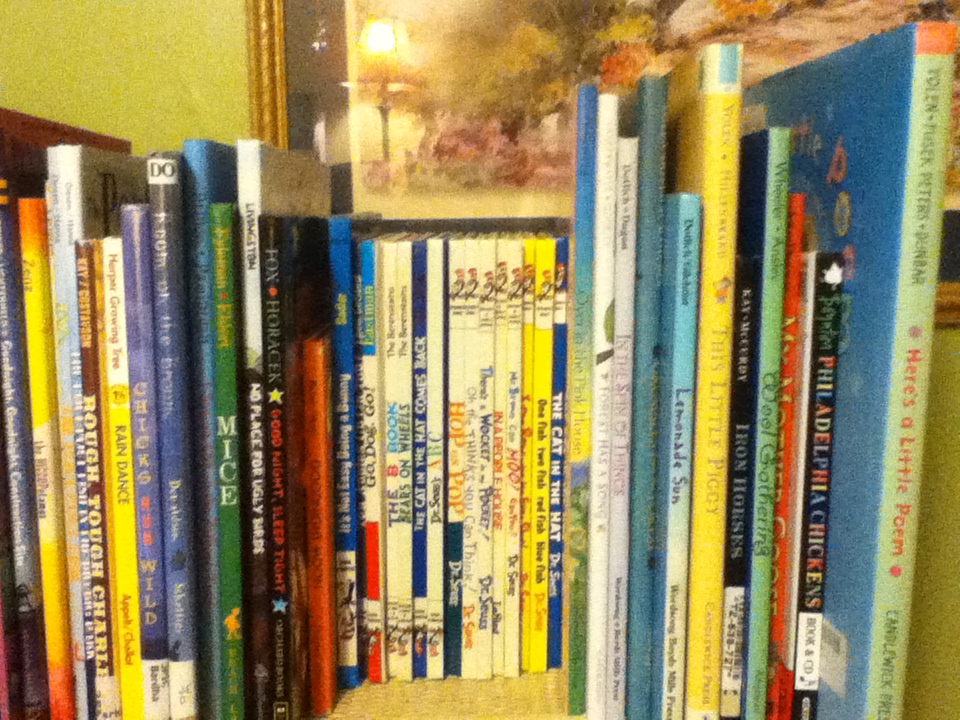
Our guest blogger for today was the first poet I ever met. It was many years ago at an SCBWI Conference in Brown County, Indiana and she was on the faculty. I had been writing rhymes and stories for kids but had never been exposed to formal poetry. I was amazed, stunned and bewildered at what she could do with words. Last week I shared pictures of my office and mentioned that my most treasured books were lovingly placed together on the second shelf of my bookcase. Here are those books…

*

Office 10

*

If you really want to study poetry and are interested in the poetic forms

that we are learning, I recommend reading every one of her books!

*

*

So, without further ado, I’m honored to present today’s

Golden Quill Guest Blogger

Helen Frost

Rhypibomo Guest Blogger Badge      Helen Frost 1

*

*

How Not to Write a Rhyming Picture Book

*

To make a rhyming picture book
look and look and look and look

*

for exactly the right word
flying like a little bird

*

across the page you’re trying to write.
Don’t quit until you get it right.

*

And when you think that you are done
send it off and see what prize you’ve won.

*

Please Do NOT attribute this “poem” to me.

*

I wrote that in approximately two minutes. What could be easier, right?

*

In each of those four stanzas I’ve done something wrong—at least one thing—how many can you identify? Take a few minutes to study that before reading on.

*

Okay—let’s take this stanza by stanza:

Stanza one: Many beginning writers, even if they have a reasonably good ear for meter, add extraneous words to make the rhythm come out right. Look for “very” or “very, very” or unnecessary repetitions of words.

*

Stanza two: Sometimes rhyme can lead you to a great metaphor or simile that you would never have found without it. This is not an example of that. A word is nothing like a little bird in this instance, and the comparison only serves to slow down the reader as they try to figure out how it might be apt. If you write something like this, and then figure out a way in which a word can be compared to a bird, go back and work on the poem until your metaphor or simile carries its meaning in a beautiful and seemingly effortless way (though of course it will not have been effortless).

*

Stanza three: Rhyming homonyms will grate on most editors’ ears.

*

*

homophone graphic

Apparently, there is a recent debate about the usage of homonym/homophone.  Helen kindly sent me the link to this article to explain the discussion. Thanks Helen!

http://www.vocabulary.com/dictionary/homonym


*

*

Stanza four: Two things here, the first being a review of Stanza one. Would anyone actually include the word “that” if they were speaking this sentence? And: An almost-right metrical pattern is worse than no such pattern at all.

*

Having said all this, there is a little nugget of good advice hidden within that bad writing. Do keep lookin for just the right words and images; don’t quit too soon; and when you’ve worked hard and written a poem that pleases you, send it off to a contest or to an editor. Let it offer it’s wisdom to the world, and may it bring joy back to you!

 *

*

Happy writing!
Helen Frost

*

*

Here’s a page from a notebook where I was working on Step Gently Out.

*

Helen Frost 3

*

*

Bio:
Helen Frost worked for about twenty years as a poet before publishing her first poetry collection, supporting herself with work she also loves, that of a teacher–in elementary schools, as a poet-in-the-schools, and at the college level. Her books include seven novels-in-poems for children and young adults, two collections of poetry for adults, two plays, a book about teaching young people to write about difficult issues, two picture books for younger readers, and two anthologies. She continues her work with children and teens through school author visits, and is now a full-time writer, living in Fort Wayne, Indiana.

http://www.helenfrost.net

Helen Frost 2

*

*

*

Thank you Helen Frost!

~~~~~~~~~~~~~~~~~~~~~~~~~~~~~~~~~~~~~~~~~~~~~~~~~~~~~~~~~~~~~~~~~~~~~~~~~~~~~~~~~~~~~~~~~~~~~~~~~~~~~~~~~~~~~

RhyPiBoMo Daily Lesson: Thursday April 3rd
By Angie Karcher © 2014
Lesson 5

*

*

Haiku

*

After yesterday’s long lesson I thought we’d visit something a bit more familiar today. Haiku is probably one of the most recognized forms of poetry.

*

Haiku is Japanese lyric verse form having three unrhymed lines of 5, 7, and 5 syllables, traditionally invoking an aspect of nature or the seasons. (Write this down)

*

*

Pagoda

*

*

The Haiku form of poetry is hundreds of years old and was originated in Japan. Haiku has its own set of fairly strict rules.

*

You need to know what a syllable is to write Haiku.

*

Syllable – the slightest portion or amount of speech or writing, how many beats a word has.
For example: dog =1 syllable, apple = 2 syllables, tomato = 3 syllables

*

*

Rules for Haiku:
1 It must be written about nature or refer to something to do with nature, for example, seasons or weather.
2 It must be written in the present tense form.
3 It should generate a picture in the reader’s mind about the subject.
4 It follows the 3 line syllable pattern of 5-7-5
5) It does not rhyme and words are not repeated

*

*

Line 1 5 syllables
Line 2 7 syllables
Line 3 5 syllables 17 total syllables

*

This is a different form of traditional poetry than cinquain but similar in the process. The more difficult form of Haiku has fewer words and more rules. This means every word must count! As picture book writers, we are familiar with this concept. We try to stay in a tight word count when writing a picture book…now you have to tell a story in 17 syllables.

*

*

Here are a few examples:

*

*

An old silent pond…
A frog jumps into the pond,
Splash! Silence again.
By Basho

*

*

Autumn moonlight—
a worm digs silently
into the chestnut.
By Basho

*

*

Lightning flash—
what I thought were faces
are plumes of pampas grass.
By Basho

*

*

Falling to the ground,
I watch a leaf settle down
In a bed of brown.
Author unknown

*

*

A summer river being crossed
how pleasing
with sandals in my hands!
By Yosa Buson

*

More examples:
http://examples.yourdictionary.com/examples-of-haiku-poems.html

*

Haiku poem

I thought this was so funny! Limerick humor… plus I’m sleep deprived!

~~~~~~~~~~~~~~~~~~~~~~~~~~~~~~~~~~~~~~~~~~~~~~~~~~~~~~~~~~~~~~~~~~~~~~~~~~~~~~~~~~~~~~~~~~~~~~~~~~~~~~~~~~~

Helen Frost quote

Limerick

*

*

A limerick is a short, humorous, nonsense poem.
(Write this down)

When I hear the word limerick, I immediately think of Ireland and leprechauns but Limericks were originated in England.
Supposedly the name is derived from Limerick, Ireland where there was a popular pub song with the refrain “Will you come up to Limerick?” Apparently, many the drunkard knew this tune and it was passed down through the years.

*

*

Limericks are, oddly enough, one of the earliest forms of poetry for children. They are written with humor in mine and were a type of nursery rhyme and storytelling.

*

The first line of a limerick traditionally introduces a person and a place, with the place appearing at the end of the first line and establishing the rhyme scheme for the second and fifth lines. In early limericks, the last line was often essentially a repeat of the first line, although this is no longer customary.

*

Writing poetry is about following the rules of rhyme, rhythm and stressed and unstressed syllables. A limerick is a good example of rule following and begins us on our baby steps of learning the rules.

*

DON’T LET ALL THE ODD NAMES OF THINGS INTIMIDATE YOU!

*

Today, we are going to learn in depth about stressed and unstressed syllables, rhyme scheme, feet, meter, iamb and anapest.

*

It’s not about remembering what they are called right now…it’s about understanding that each type of poem has a different rhythm and rhyming pattern.

*

So for now, all we have to do is follow the rules!

*

Keep a page in your notebook with definitions, rules, etc. so you can refer back if you need to.

*

For the lesson today, we will also be doing MATH!

Yes, math is the key to understanding metrical feet and its different patterns.
If you can listen, count and track the stressed syllables, you will get this!

*

*

Syllable – the slightest portion of a word or how many beats a word has.

*

Example: dog =1 syllable, apple = 2 syllables, tomato = 3 syllables

*

*

When you were learning to read, your teacher had you clap out the syllables of words to help you count how many beats there were in each word. This also helps you learn to listen to the word and its parts.

*

When learning to write poetry, we study word sounds and their parts. We are talking about words with two or more syllables. Listen for the part of a word that has more emphasis, or stress on it, than the other part of the word.
*

*

If you look in a dictionary the stressed part of the word is usually in boldface.

*

*

*

For example:
Apple (ap – uhl)
Argue (ar – gyoo)
Artist (ar – tist)
*

Try saying these words with the stress on the wrong syllable…

*

Not correct

Ap-ple        Ar-gue          Ar-tist

*
When the stress is on the wrong syllable, the words sound very strange and awkward and it’s certainly not how we pronounce them.

*

*

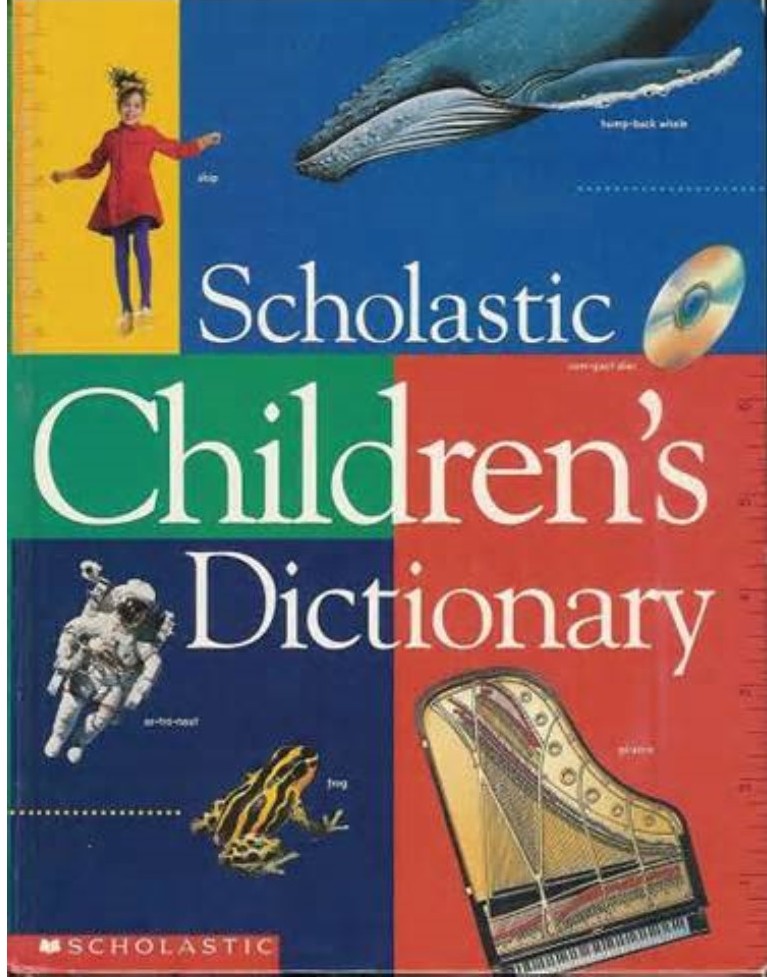
FYI – I sometimes refer to a Scholastic Children’s Dictionary as it is very basic and has minimal definition…it gets to the point and is simply written. It is also easy to find the stress of the word syllables if you are unsure.

*

*


dictionary

http://www.amazon.com/Scholastic-Childrens-Dictionary-Inc/dp/0439365635

*

*


Now, let’s look at 3 syllable words …

*

Potato (puh-tay-toh)
Pottery (pot-ur-ee)

*

and 4 syllable words…
Preposition (prep-oh-zish-uhn)
Preoccupied (pree-ok-yuh-pide)

*

*

Writing Exercise: Make lists of 2, 3 and 4 syllable words and then highlight the stressed syllable in each word. Add at least 10 words to each list so you get very comfortable finding the stressed syllable. You could guess and then check to see if you are right with a dictionary.

*

Earlier this week we learned about Rhyme Scheme. Well rhyme scheme is very specific with a limerick.

*

Rhyme Scheme is…
The pattern of rhymes used in a poem, usually marked by letters to symbolize corresponding rhyming end words.
The rhyme scheme for a limerick is AABBA.

*

*

The basic rules for writing a limerick:

*

*
1)A traditional limerick often starts out with, “There was once a…” but not always. As with any   rule, there are exceptions which we will talk about in a minute.

2)The ending of the first line is usually the name of a place, town, or country.

3)A Limerick is a 5 lined poem.

4)Lines 1,2 & 5 rhyme with each other.

5)Lines 3 & 4 rhyme with each other.

6)The first, second and fifth lines should have eight or nine syllables.

7)The third and fourth lines should have five or six.

8)Lines 1, 2 & 5 have 3 feet.

9)Lines 3 & 4 have 2 feet.

*

*

What? Feet? Don’t Panic! WE WILL TALK ABOUT FEET NOW!

feet

*

Remember, children write limericks so we can do this! Don’t shut down now and think this is too complicated! Think of it as a game or a puzzle. You have to take one rule at a time and make your words fit into those rules. It’s challenging and fun! This is where we listen for the stressed and unstressed syllables.

*

*


Metrical Feet are a measurement of the sounds of words…it’s a way to measure the pattern of stressed and unstressed syllables in a word. (write this down)

*

It sounds way more complicated than it really is…
A foot – is a unit of measurement that is repeated within a line of poetry. (write this down)

*

*

For example:
*

Da-da-dum, Da-da-dum, Da-da-dum

Even a nonsense word like dadadum has a stressed syllable.
If this was a line of poetry, it would have 3 metrical feet or 3 repeating patterns of sound.

*

Da-da-dum is one foot

*

*


I’m not sure measurement is the best word to use…it’s really just a way to identify, or group together, certain patterns of stressed and unstressed syllables.

*

Da = an unstressed part of the word

Dum = the stressed part of the word…this part gets more emphasis when we say it.

*

*

(If you compare this to music, a foot could be compared to the measures in music. When you put all the measures together, you get the whole song. If you play lots of sharps and flats, it might be Jazz. It you play lots of slow, melodic notes it might be a ballad. These are just names for the type of music.)

*

*


This particular metrical foot is called an Anapest. An anapest is the name for a type of foot.

*

An Anapest is the name of the pattern of sound in a poem with 2 unstressed syllables followed by a stressed syllable (da-da-dum) (write this down)

*

*

Now, let’s just say that we had all one syllable words in a line of poetry.
One syllable words don’t have a stress. But…when they are put with other one syllable words the phrase has stressed words and unstressed words.

*

For Example:
In the night on the dock I see stars
Da-da-dum, Da-da-dum, Da-da-dum

*

Now, mix the line with one and 2 syllable words.

*
In the night there’s a tur-key who gob-bles at will
Da-da-dum, Da-da-dum, Da-da-dum, Da-da-dum

Say it out loud so you hear the stressed word parts!

*

Here’s another example:
Twas the night be-fore Christ-mas and all through the house
Da-da-dum, Da-da-dum, Da-da-dum, Da-da-dum

*

Meter – when you add all the feet together, that creates the meter of a poem. This is the rhythm or the cadence of the poem. It’s something you feel when you read it and it changes the way you say it compared to a prose phrase. (write this down)

*

A limerick has a certain “rhythm” created by how the syllables are stressed.

*

Many limericks have an Anapaest meter but not always.
(Just remember Da-da-dum!)

*

Please visit this site and read about metrical feet over and over until it makes sense. There are diagrams of feet and everything!

The best explanation of metrical feet I’ve found is at Rhymeweaver.com
http://www.writingrhymeandmeter.com/?page_id=1880

 feet

*

*


Now that we know about feet, we are back to the rules of a limerick.

*

Here is a checklist of the rules for your convenience:

*
□ 1)A traditional limerick often starts out with, “There once was a …”
□ 2)The ending of the first line is usually the name of a place, town, or country.
□ 3)A Limerick is a 5 lined poem.
□ 4)Lines 1,2 & 5 rhyme with each other.
□ 5)Lines 3 & 4 rhyme with each other.
□ 6)The first, second and fifth lines should have eight or nine syllables.
□ 7)The third and fourth lines should have five or six.
□ 8)Lines 1, 2 & 5 have 3 feet.
□ 9)Lines 3 & 4 have 2 feet.

*

*

Refer to the rules above with this nonsense poem and see if we have followed all the rules.

Da-da-dum, Da-da-dum, Da-da-dum
Da-da-dum, Da-da-dee
Da-da-dum, Da-da-dum, Da-da-dum

*

*

Yes, by George, I think we’ve got it!

*

*

Here is an example of a traditional limerick with Anapest meter.

*
There was once a young fel-low of Wall
Who grew up so a-maz-ing-ly tall
That his friends dug a pit
Where he’d happ-i-ly sit
When he wished to con-verse with them all

*

One of the exceptions: Sometimes a limerick might start out, “There once was a…” and that’s a different foot all together.

*

This type of metrical foot is an iamb.

*
An Iamb an unstressed-stressed pattern (write this down)

*
Da-dum, Da-dum, Da-dum, Da-dum,
Many traditional limericks start with 1 iam followed by 2 anapests

*
For Example: Da-dum, Da-da-dum, Da-da-dum

*

Here is a traditional limerick with 1 iam and 2 anapest feet.

*

There was a young wo-man named Bright,
Who tra-veled much fas-ter than light,
S0 she set off one day
In a rel-a-tive way
Re-turned on the pre-vi-ous night.

*

*

Another example:
There once was a man from Nan-tuck-et,
Who kept all his cash in a buck-et,
But his daugh-ter, named Nan,
Ran a-way with a man,
And as for the buck-et, Nan-tuck-et.

*

Up to this point, I have been signifying the stressed syllable with the color red.

*

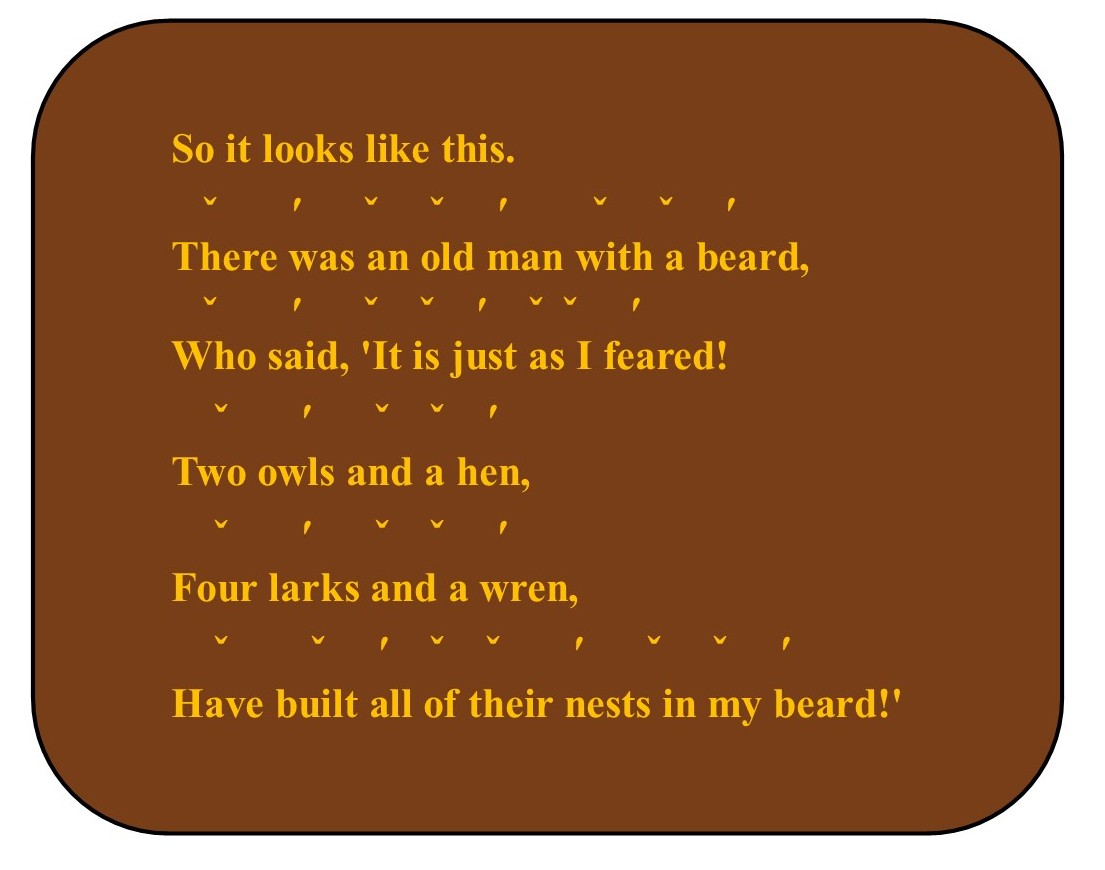
The proper way to signify an unstressed syllable is with the symbol ( ˇ ) and for a stressed syllable we use ( ʹ ) over each word.

For example:

Stress symbols

*

*

My favorite resource book for learning about poetry so far is titled  POEM MAKING by Myra Cohn Livingston.

I highly recommend it!

*

Here is the link:
http://www.amazon.com/Poem-Making-Ways-Begin-Writing-Poetry/dp/0060240199/ref=sr_1_1?ie=UTF8&qid=1396320950&sr=8-1&keywords=Poem+Making+by+Myra+Cohn+Livingston

*

*

There are other common metrical feet that we will cover later this month. They are: dactyl, spondee, trochee.

*

*
Today’s post was briefer than yesterday’s but it was full of more meat and potatoes! This may be one of the most important lessons to understand as the foundation to learning rhythm, meter and scansion are hiding here. Go back and read everything out loud now…that will help!

*
I hope this is making you thirsty for more rhyme and poetry! We should have a lemonade social at the end of April…by then we will be professionals at making lemonade from all these sour, lemony, poetry lessons.

*
Don’t think that you have to get it all in one day. We will be revisiting most of what we learned again later in the month.

Squeeze those lemons and add lots of sugar!

                   ~Angie

*

Resources for Haiku and Limericks:

http://www.haiku.com/

http://www.poemhunter.com/poems/haiku/

http://www.famousliteraryworks.com/limericks.htm

http://www.poemhunter.com/poems/limerick


*

*

*

Writing Prompt: Write a haiku and a limerick!  And have fun!

*

*


Okay, now do everything else on the pledge for today and don’t forget to comment on today’s blog post!

RhyPiBoMo Pledge


Please comment ONLY ONE TIME below for a chance to win today’s prize!

Prizes will be drawn by Random.com next Sunday for the previous week.

To be eligible for a prize you must be a registered participant and
comment after each days lessons.

Have a RhyPiBoMo Wednesday!

Welcome to Rhyming Wednesday!

I am thrilled with the participation on the blog and in the Facebook Group! You are all so generous with your comments and in sharing wonderful resources for the rest of us!

Writers are the best! Really !!

*

*I wish I could help but unfortunately all the RhyPiBoMo Critique Groups are closed as of last Saturday.

So, if you are still in need of a group click the tab above that says “NEED A CRITIQUE GROUP”

Read and follow all the directions.

You will be on your own to find a group but this will allow you to connect with others who also want to join a group.

Please do not ask a question about critique groups in the comments as I am not able to help with this process due to time limitations and the amount of comments posted.

*

*

*

So, without further ado, I’m honored to present today’s

Golden Quill Guest Blogger

Rebecca Kai Dotlich

*

*
 

Rhypibomo Guest Blogger Badge        Rebecca Dotlich 1

Rebecca was so kind to call and ask what she should write for RhyPiBoMo. We tossed around a number of topics, but ultimately decided to share a wonderful blog post she wrote for Julie Hedlund’s 12 X 12 back in August, 2013. This information was a perfect fit for RhyPiBoMo…no need to reinvent the wheel here! She kindly sent a short note with her thoughts on writing rhyme…

*

The note from Rebecca…

*

A note to those trying to get into the children’s publishing world:
If writing is your passion, if you are dedicated and you work hard at your craft, don’t let anyone or anything discourage you enough to quit. I have always said, and still do, I would have written until the day I died. I would still be trying.
Publishing is the gold, the prize, the tip of the journey, but it isn’t THE journey. Writing is the journey; learning, getting lost in story and words, and working at your craft day after day, year after year.
BTW: Remember that most editors and agents discourage writers from writing and submitting rhyming picture books because they see so much that isn’t written professionally and with a good sense of meter and rhythm and most of all — those same manuscripts most likely incorporate forced or inverted rhyme.
But if you are trying to break in with a rhyming picture book, and you’re fairly certain you’ve conquered these obstacles, go for it! And keep going for it.
The most true TIP I have to offer: Read stacks of books in the genre you want to write. Rhyming picture books?
Read all the newer ones on the bookstore shelves — and all the traditional tried and true ones from the library shelves. Then read them again.
Then type them out and look at the text without illustrations.
Then read them again.

 *

*

And now, Rebecca’s blog post…

*

*

FAR FROM THE SEA AND THE SALT IN THE AIR
Or
Using Poetic Devices to Create Picture Books

*

*

The title of this post is a line from Barbara Cooney’s MISS RUMPHIUS. It is also a perfect line to demonstrate lyricism and the use of poetic devices found in picture books.

*

These few words strung together make music; “. . . far from the sea and the salt in the air.” They also spark our imagination, and give an aura of wonder and mystery. This line could have been much less poetic. It could have been written like this: “She left home and went to live in another city that was miles away from the ocean.” That would have been a well-written line. But it just doesn’t evoke the same feeling.

*

Often, writers mistakenly think alliteration is simply a succession of the same first letters of two or more words placed side by side on the page. And in an honest attempt to try and nail this poetic device, will mistakenly go for the neon-lighted-here-I-am-am kind of alliteration. (Robo the raccoon cooked creamy carrot soup.)

*

In the example above, the f in far and from are indeed side by side on the page, but they fit there seamlessly. There are many ways this line could have been written. (A long way from, Out from, Away from, etc.) But joining the word far with from makes this line sing. It seems like such a simple thing. And often it is. And it’s what works.

*

Same with the s in sea and salt. Still using the s but replacing shore for sea, you notice it doesn’t have that same poetic ring, that lyrical quality. Far from the shore and the salt in the air. Just isn’t the same, is it? Proving that all alliteration is not created equally. Sea and salt. Shore and salt. Listening to your word choices and lines aloud, over and over and over again, is the best way to determine if you have made the right choices. If not, it’s back to the drawing board.

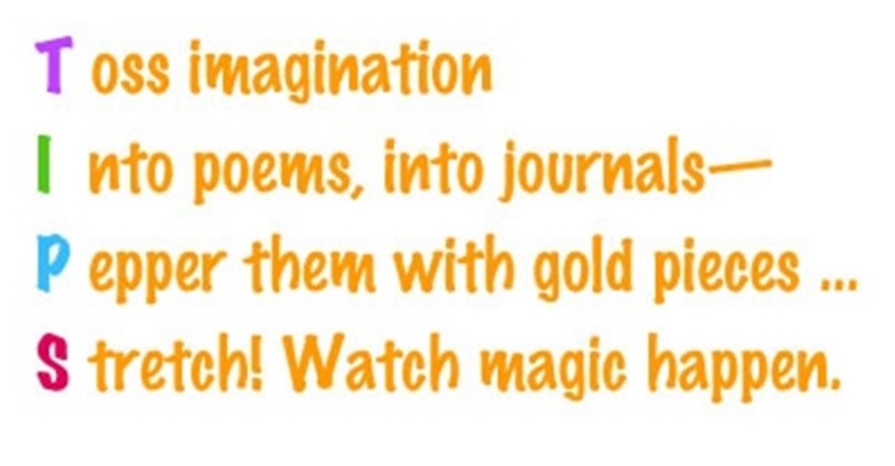
*Writing tips

*

*

There are thousands of examples similar to this, of course. As you read through stacks of picture books you will discover them. You can’t ask for better teachers than the books themselves. There are brilliant articles and educators that will dive in and come out with a much better roadmap for a post like this than I can. But this is my roadmap, and I am, no doubt, trying to simplify a complex subject. But here are a few thoughts:

*

As you craft your picture book, keep in mind all the tools and poetic devices at the ready; imagery, personification, metaphor, repetition. Rhyme and rhythm are two very important poetic tools, but by far not the only ones. As you are writing your picture book, listen to the sounds of the words. Remember that something lovely and lyrical (like the Cooney example, above) is only one way of adding a poetic feel to your picture book. Be aware of these poetic tools as you write, but not focused on them. And whatever you do, don’t demand your muse to use them all.

*

Write sentences that flow organically, or seem to. They won’t really flow organically of course, but the goal is to make it look that way. The reader wants to feel like he isn’t stumbling or tripping over rhythm that is off, rhyme that is forced into a corner, or language that is so lovely-contrived, it ends up being jarring to both tongue and ear.

*


Children love wordplay (palindromes, anagrams, spoonerisms, etc.,) but they also love to play with words (fascinating words, difficult words, clever, whimsical and silly words.) Dabble in the playground of fanciful and unexpected. Noodle in imagery; pull words from the magical pot called imagination. (Some people call it Thesaurus.) In truth, it’s both. And remember that every word counts. Every. Word.

 *

*

Rebecca Dotlich 2

*

*

My rhyming picture book WHAT CAN A CRANE PICK UP? (Illustrated by Mike Lowery, Knopf, September 2012) began with one poetic device; repetition. I didn’t consciously do it, it just happened like most ideas: driving in the car, my grandson (then about 6 or 7) and I were talking as he pointed out construction sites, highway work, a crane lifting a concrete barrier:

*

Ian: Can a crane pick up a crane?

Me: It sure can.

Ian: Can it pick up a truck?

Me: Yep, a truck too. (And then, being silly). . . and a truck, and

a truck, and a . . .

*

And he laughed. (You had to be there.) And we proceeded to name all the things cranes might pick up. And we were making a book. We kept repeating it as we went, so we wouldn’t forget our collection of ideas. A part of the text reads like this: “. . . Watch as cranes with chains and hooks lift cartons and cages and library books! See the cranes with slings and straps lift cuckoo clocks and baseball caps.”

*

I point this out to make a few points. The alliteration of cranes, cartons, cages, cuckoo clocks and caps would have been too much without the other words popped in to cushion them. This is only decided after many drafts and many readings aloud. The word cuckoo? I had a long list of clocks. Tower clocks and alarm clocks and mantel clocks and many more. I actually didn’t choose cuckoo for its alliteration. I chose it because it is fun to say. The addition of rhyme for this book came after the idea, after the loose use of repetition, and after the list of things a crane can pick up. I decided to layer it with rhyme after a straight prose approach didn’t seem playful enough to me.

*

Rebecca Dotlich 3

Rhyme can engage the young child like nothing else. But the rhyme must be good, natural, easy. Never forced. What is forced rhyme? Many writers ask that. The answer is simple. An end rhyme must complete the thought the way you want it to, must express the idea you are truly trying to get across to the reader, not in a convoluted, these-two-words-rhyme, kind of way.

*

The two picture books I highlighted here are as different as night and day. One is a lyrical, wondrous beauty of a picture story book. The other is a whimsical rhyming romp about a construction machine. Both are picture books, and both use poetic devices. One to tell a story, and the other to engage and entertain the child in a playful way.

*

Children, and especially very young children, are enchanted by rhythm, rhyme and repetition. They almost feed off of predictable language patterns, being entranced by the sound of the words, the cadence of the line, and the delicious knowledge that they are exactly sure what’s coming next. Being able to chime in to jump rope and nursery rhymes, song lyrics, prayers and cheers has always been, and will always be, one of life’s purest joys. Lines from picture books do this too, and can they ever. From the youngest babe to the elderly grandfather, who doesn’t love to repeat the words to a poem or song they know, or once knew, or will forever know in the vault of their heart.

*

*

*

Bio:
Rebecca Kai Dotlich grew up in the Midwest exploring trails by the creek, reading comic books, making paper dolls and building snowmen. She is a children’s poet and picture book author of titles such as Bella and Bean (an SCBWI Golden Kite Honor) and What Is Science? (Subaru SB&F finalist and Bank Street’s Best Book of the year.) She gives poetry workshops, visits classrooms across the country, and speaks at conferences, retreats, libraries and schools to teachers, aspiring writers and students of all ages. Her books have received the Gold Oppenheim Toy Portfolio Award as well as an IRA Children’s Choice and her work has been featured on Reading Rainbow and the PBS children’s show Between the Lions. She is the grandmother of four. Rebecca still reads comic books and builds snowmen. WHAT CAN A CRANE PICK UP? (Illustrated by Mike Lowery) received a *starred* review from Publisher’s Weekly. Following WHAT CAN A CRANE PICK UP? is ALL ABOARD! forthcoming in fall 2014.

*

*

Rebecca Dotlich 4


Please enjoy this book trailer for What Can a Crane Pick Up?
http://www.youtube.com/watch?v=MkNoQ6TcVDs


*

*

 Thank you Rebecca Kai Dotlich!

*

*

~~~~~~~~~~~~~~~~~~~~~~~~~~~~~~~~~~~~~~~~~~~~~~~~~~~~~~~~~~~~~~~~~~~~~~~~~~~~~~~~~~~~~~~~~~~~

*

RhyPiBoMo Daily Lesson: Wednesday April 2nd

By Angie Karcher © 2014

Lesson 4


First of all, this is a VERY long post so please don’t get overwhelmed…The rest of the posts will not all be nearly this long. I wanted to share the lyrics of several songs and that made it very long!


 Ballad

Folk ballads are the oldest type of poetry known. Traveling storytellers would often set stories to music, thus the ballad was born. Many older ballads are by anonymous authors as they were not written down but passed verbally from person to person. For this reason, there were many versions of the same story as each storyteller gave the story their own personal touches. Most ballads were about bravery, love, death and dark, depressing subjects.

*

There are certain distinctive features that make up a ballad. It typically describes a dramatic event, has lots of action, but told in a simple way. Ballads were written by the working man for the working man to commiserate their difficult lives as laborers and hard-working folks. I found this ballad written by my favorite storyteller, James Taylor.

*

This ballad, Millworker, is from a book titled WORKING by author Studs Terkel that was later made into a Broadway show. James Taylor wrote and performs this song titled Millworker.

*

*

Studs Terkel


The Lyrics to Millworker by James Tylor

http://www.lyricsfreak.com/j/james+taylor/millworker_20069194.html

James Taylor

Mr. James Taylor 

My favorite storyteller! If you ever get a chance to see him in concert…Do it!

*

*

Here is a Youtube Link to Millworker by James Taylor

http://www.youtube.com/watch?feature=player_detailpage&v=vg2D714gn2w

*

Often a ballad has a repeating refrain.


A Ballad is …a narrative poem, often of folk origin and intended to be sung, consisting of simple stanzas and usually having a refrain. (Write this down)

*

*

Now that you are really depressed after reading about the “Millworker,” I’ll share a few ballads that are a bit more uplifting. Yankee Doodle is one such ballad. We sang it as kids and teach it to kids today but even Yankee Doodle has a dark side.

I highlighted the lyrics in hot pink because it was written and sung by British troops in the mid 1700’s to taunt and make fun of Colonial troops about how femininely they dressed. The British thought that the Colonial soldiers were foolish, uneducated, unsophisticated men that spent too much time watching horse racing and socializing. Their clothing and floppy, feathered hats gained them the name “Macaronis” and was the source of teasing that inspired this “not-so-nice” ballad. Who knew?

*

*

Yankee Doodle

*

*

Yankee Doodle Lyrics Author Unknown

A       Yankee Doodle went to town

B      A-riding on a pony,

C       Stuck a feather in his cap

B       And called it macaroni.

*

         Chorus:

A       Yankee Doodle keep it up,    

B       Yankee Doodle dandy,

C      Mind the music and the step,

B       And with the girls be handy.

 *

A       Father and I went down to camp,

B       Along with Captain Gooding,

C       And there we saw the men and boys

B       As thick as hasty pudding.

*

      Chorus

A       There was Captain Washington,

B       Upon a slapping stallion,

C       Giving orders to his men-

B       I guess there were a million.

Rhyme Scheme is the pattern of rhymes used in a poem, usually marked by letters to symbolize corresponding ending sounds. (write this down)

*

Yankee Doodle is written in a common ABCB Rhyme Scheme. This means that each line gets a letter that correlate with the ending words that rhyme to determine the rhyme scheme. If the ending words rhyme, those lines are given the same letter.

*

A-Town

B-Pony

C-Cap

B-Macaroni

*

These are the ending words in each line. Town doesn’t rhyme with anything so it gets the letter A by itself.

Pony and Macaroni rhyme so they both get the letter B

Cap doesn’t rhyme with anything so it gets the letter C by itself.

This rhyme scheme is ABCB.

Throughout the rest of the poem each stanza follows this scheme.

Yankee Doodle is written in 4-line stanzas.

A Stanza is a Rhyming pattern that forms a group (write this down)

*

*

Another ballad you probably know is Clementine. This seems an obvious sad story written during the 1849 Gold Rush about a miner and his daughter. It is actually a humorous ballad written in a tongue-in-cheek style, making fun of the typical drama that accompanies most ballads. For example, Clementine’s feet are so big she has to wear boxes for shoes. Clementine managed to get a splinter in her toe and drown as her father didn’t know how to swim. So Clementine is a humorous, tragic ballad.

*

*

Clementine

*

Clementine Lyrics Author unknown

A       In a cavern, in a canyon,

B       Excavating for a mine

C       Dwelt a miner forty niner,

B       And his daughter Clementine

                  Chorus

A       Oh my darling, oh my darling,

B       Oh my darling, Clementine!

C       Thou art lost and gone forever

B       Dreadful sorry, Clementine


A       Light she was and like a fairy,

B       And her shoes were number nine

C       Herring boxes, without topses,

B       Sandals were for Clementine.

Chorus

A       Drove she ducklings to the water

B       Ev’ry morning just at nine,

C       Hit her foot against a splinter,

B       Fell into the foaming brine.

Chorus

A       Ruby lips above the water,

B       Blowing bubbles, soft and fine,

C       But, alas, I was no swimmer,

B       So I lost my Clementine.

Chorus

A       In a churchyard on a hillside

B       Where the flowers grow and twine

C       There grow roses amongst the posies

B       Flowers for my Clementine.

Chorus

 *

* 

A Youtube Video of Clementine by Lew Dite on his Ukelele

http://www.youtube.com/watch?list=RDRUzQy4mmT3Q&v=RUzQy4mmT3Q&feature=player_detailpage

*

*

Some Ballad Resources:

http://www.mahalo.com/how-to-write-a-ballad-poem/

http://www.creative-writing-now.com/how-to-write-poetry.html

http://www.kirstymurray.com/mktblues/wrtpen/Ballads.gif


So why do we need to know about ballads? Because…they are easy to remember because of their rhyme and rhythm. Remember yesterday when we talked about how rhyme helps kids to remember words and parts of language? Well, when you sing a poem, a ballad, it helps you to remember the words. Music is a clue that helps us remember the words to the poem, or song.

*

Plus, ballads are one of the earliest and most basic forms of storytelling. That is what we do. We are storytellers and can certainly learn from those who used music to capture their audience. Plus, Yankee Doodle was written in the 1700’s and Clementine in 1849. I hope someday a story I write is remembered, recited and discussed by writers 150 – 200 years from now!

*

*

Cinquain [sing-keyn]

 *

A Cinquain is a stanza with five lines and each line has a required number of syllables.

2-4-6-8-2 syllables (Write this down)

 *

So, you may be wondering why I have plopped cinquains down so early in this process of learning about poetry? Ballads were a pretty straight forward concept and easy to understand their origin and why they are still enjoyed today.

*

It’s time to get out of your comfort zone! We are going to jump right into the icy water with our clothes on! 1-2-3…JUMP!

*

It’s because I want you to start really evaluating every word when you read a poem. Look for patterns, rhythms, syllables, rhymes, meanings, etc. The word cinquain sounds intimidating, as will many of the other words we learn. But, that doesn’t mean the concepts are hard…just new.

*

It was developed by Adelaide Crapsey who probably borrowed the idea from Haiku. It is not difficult once you first, know what it is and second, know how to write one. Writing a cinquain is about following the rules. In fact writing poetry and rhyme is all about following the rules. All we have to do is learn the rules, write them down, glue them into our brain and then…follow them.

*

The key to understanding a traditional cinquain is finding the syllable count. The beats-per-line is the syllable count. Clap your hands every time you hear a different vowel sound (A-E-I-O-U) of a word.

*

*

*

Examples:

1 syllable    (Dog)

2 syllables   (Kit—ten)

3 syllables   (Cu—cum—ber)

4 syllables   (Wa—ter—me—lon)

*

*

When counting the syllables in a line, you can count syllables in multiple words. For example: Upon a starry night

6 Syllables  (Up—on—a—star—ry—night)

*

The rules of a cinquain are about the syllable count allowed in each line.

line 1 – 2 syllables

line 2 – 4 syllables

line 3 – 6 syllables

line 4 – 8 syllables

line 5 – 2 syllables

*

Here is an example of a well-known cinquain.

November Night

By Adelaide Crapsey

2        Listen…

4        With faint dry sound

6        Like steps of passing ghosts,

8        the leaves, frost-crisp’d, break from the trees

2        And fall.

*

*

Notice these lines don’t rhyme. Remember when I said earlier that rhyme is really a small part of writing poetry? Well, now we are diving into the chilly water of BOM, BOM, BOM…THE NON-RHYMING ZONE!

*

I want you to stop thinking about rhyme for a while and completely focus on everything else about the language. Read, hear, see, smell, taste and touch the words used. We will get to the rhyme later but for now, trust me and just follow the rules.

*

 *

Here is my first attempt at writing a traditional cinquain.

2        Sleeping.

4        My eyes are shut,

6        My brain won’t go to sleep.

8        The story doesn’t want to keep.

2        I’m up!

*

*

Here’s Another

2        Lucy,

4        A dachshund kiss.

6        Her wagging tail, a smile,

8        Tilted head with begging banter.

2        A treat!

*

*

This wasn’t as easy as I thought it would be, but it was fun! There are many, many other more contemporary forms of cinquains that are written by many poets today. They have very strict rules and can get complicated quickly but if you follow the rules, one line at a time, you can do it! I found that the examples given were a huge help. To me, this is like doing a word search or a crossword puzzle. I love the challenge!

.

*

Contemporary Cinquain

*


*

Contemporary Cinquain Rules:

Use the same rules about syllables as for traditional but add the rules on the left as well.


One word title                                                                                 2 syllables

2 adjectives that describe the topic                                           4 syllables

3 words that express action                                                         6 syllables

4 words that express a feeling                                                     8 syllables

1 word that refers to the title                                                       2 syllables

*

 *

                                                                                                                      TOTAL 22 syllables

*

My first attempt at a contemporary cinquain:

*

Summer

Heated, desired

Melting winter sorrow

Gentle yearning for the morning

Sunshine                                                                        22 Syllables

*

*


Another example:

FRIENDSHIP

Friend/ship

Pre/cious, awe/some

Bright/ens gloom/y mo/ments

Rain/bow’s treas/ure trove dis/cov/ered

Al/ways

*

*

Some Cinquain Resources :

http://www.poetry4kids.com/blog/lessons/how-to-write-a-cinquain-poem/

http://ettcweb.lr.k12.nj.us/forms/cinquain.htm

http://hrsbstaff.ednet.ns.ca/davidc/6c_files/Poem%20pics/cinquaindescrip.htm


*

As I read over this post, I hope I’m not over explaining. Remember, I’m a kindergarten teacher by trade, and I’m used to working with 5 year olds. I apologize if anything sounds condescending or too simplified. As we have writers here of all experiences and abilities my hope is to keep things as simple as possible. Also, each blog post will hopefully stand alone as a lesson so if I repeat words or concepts that is the reason…plus repetition may help us remember better.

*

I know this was a long post but we had a lot to cover and hopefully, the examples help to explain. We are still alive after jumping into the frozen waters of poetry but even though we might be shivering and shaky, we will live to see another poem. Stay warm! Spring is here…right!?

                                                                                                                  ~Angie

*

*

*

Writing Prompts:

Write a short ballad about participating in RhyPiBoMo. Oh…the sorrow!

Write a Traditional Cinquain

And if you are feeling really brave write a Contemporary Cinquain

*

*

*

Okay, now do everything else on the pledge for today and don’t forget to comment on today’s blog post!

 RhyPiBoMo Pledge

Please comment ONLY ONE TIME below for a chance to win today’s prize!

Prizes will be drawn by Random.com next Sunday for the previous week.

To be eligible for a prize you must be a registered participant and
comment after each days lessons.


No Foolin’ Around! Let’s Write Rhyming Picture Books!

Welcome to Tuesday’s post!

*

I’m afraid to even say it out loud but

“Everything seems to be running smoothly…”

I say while knocking on my wooden desk!

*

*

Our Facebook critique groups are signed up and submissions for this week have begun.  We continue to grow daily in numbers of those registering and those requesting to join the Facebook group. We have over 150 people registered as of last night!

*

*

Please check out the Facebook Group as we have a wonderful group of generous members who are sharing lots and lots of resources that aren’t listed on this blog. I want to also say welcome to several of our guest bloggers who have joined the group. Thank you SO much for your support of RhyPiBoMo!

*

image

*

Before we get going today, I want to say thank you to my friend Gayle Wing O’Donnell, a very talented artist and friend who created the logo for this event. I held a small contest last November and she won the opportunity to create the logo with her lovely parchment background and Willy S. boldly proclaiming “The rhyme’s the thing wherein we speak the words and let them sing”

Thank you so much Gayle!

*

*

So, without further ado, I’m honored to present today’s

Golden Quill Guest Blogger

Corey Rosen Schwartz

 *

*

Rhypibomo Guest Blogger Badge                 Corey R Schwartz 1

Primed for Rhyme

I used to think that there were two types of books: plot-driven and character driven. Then, I met Simone Kaplan at an SCBWI conference and was told that my manuscripts actually fall into a third category: language-driven.

*

*

I love words.

Big words.

BOLD WORDS.

Swirly words.

STOUT words.

*

*

I am much better at stringing together a lovely lyrical line of words than I am at creating a quirky character or compelling plot.

*

*

Sometimes my writing partner will say to me, “Maybe we should write this PB in prose?” And my response is always, “And maybe Derek Jeter should play for the Jets?”
Rhyme is what I do best. Why would I abandon the best weapon in my arsenal?
Here’s how you know you should be a rhymer.

*

*

1

Do you adore alliteration?
Inside a cramped and crowded coop,
a busy brood was packing.
Folding, cramming, suitcase-jamming,
sorting, stuffing, stacking.
Repeat consonant sounds to tickle the tongue.

*

*

2

Do you worship word play?
He scrambled up the window blinds
he nibble-nipped the seats.
he dangled from the chandeliers
and swiss-cheesed Sherlock’s sheets.

Mouse with Cheese

 Play with parts of speech to stretch the imagination.
As night approached, his comic heroes
set his thoughts a-tickin’.
“Batgoose wouldn’t duck and hide.
I’m small, but I’m no chicken!”

*

*

Corey R Schwartz 3

*

*

Play with puns to add some fun.

*

*

3

Does gibberish make you squibberish?
One blustery, gustery,
dustery day,
a hippo named Grace
gazed out at the gray.
There are 988, 968 in the English language. But why let that hold you back? If you find that there is a gap in the lexicon, fill it in yourself!
Sprinkle in some gibberish to make your story stand out.

*

*

If you answered “yes” to these questions, then your

mind may be primed for rhyme

So, cherish that talent and run with it.

*

*

*

Bio:
Corey Rosen Schwartz is the author of The Three Ninja Pigs, Goldi Rocks & The Three Bears and the forthcoming Ninja Red Riding Hood. Her singing is extremely pitchy, but she does hold Family Idol and X Factor events in her living room.

*

Some of Corey’s awesome books:


Corey R Schwartz 2                 Ninja Red Riding Hood

*

*

HOP! PLOP! (Walker, 2006)
THE THREE NINJA PIGS (Putnam, 2012)
GOLDI ROCKS & THE THREE BEARS (Putnam, Feb 2014)
NINJA RED RIDING HOOD (Putnam, July 2014)

WHAT ABOUT MOOSE? (Atheneum, 2015)


*

Please visit:

*

Website: http://www.coreyrosenschwartz.com
Facebook: https://www.facebook.com/CoreyPBNinja

Twitter: @coreypbninja


Thank you Corey Rosen Schwartz!


~~~~~~~~~~~~~~~~~~~~~~~~~~~~~~~~~~~~~~~~~~~~~~~~~~~~~~~~~~~~~~~~~~~~~~~~~~~~~~~~~~~~~~~~~~~~~~~~~~~~~~

 RhyPiBoMo Daily Lesson: Tuesday April 1st

By Angie Karcher © 2014

Lesson 3

*

*

Why Do You Write in Rhyme?

*
You created a list on Sunday of why you write in rhyme. It is very important that you think about this question! Many of you have been told like I have that rhyme is hard to publish. Many editors don’t accept rhyme. Don’t write in rhyme. Yet, we are all here, together, with this wonderful group of hard-headed people who are fighting for our rhyme! I am very passionate about this subject. I guess you are too.

*
Psssss….When an editor says they don’t accept submissions in rhyme…many times that is code for we don’t publish stinky rhyme! Not always, but often, that is the case.

*

They have legitimate reasons for being hesitant about rhyme. It is difficult to do well and they are INUNDATED with terrible, horrible, no good, very bad rhyme! It is difficult to sell internationally as it doesn’t translate as a book in prose does.
But…when an editor who doesn’t accept rhyme comes across a sparkling manuscript, glowing with brilliant rhyme and singing, poetic stanzas with a rainbow arc of hook, line and sinker…he/she tears up, bites the hook and then publishes it right away!
So what do we do? Decide if we are passionate enough to do it right. To type until our fingers bleed the good stuff that rhyme offers. Are you dedicated to this really difficult path to publication? Why do you write in rhyme?

*

*

I write in rhyme because:
It’s fun to write.
It’s fun to read.
It’s challenging, like doing a crossword puzzle.
It’s such a great feeling when you find that gem of a word that says exactly what you want to say…and it rhymes in the perfect spot.
Kids love to read and listen to a rhyming story.
I can use silly, word play to make the words visual and entertaining to the ears.
I grew up reading Dr. Seuss books and fell in love
I like writing humorous poetry and when it rhymes, it adds to the humor.
It seems innately natural for my brain to lean towards rhyme.
Rhyme is very beneficial for kids in many ways.

*

*

As a former kindergarten teacher and developmental therapist, I know the importance of rhyme. Children should be introduced to rhyme at an early age as it helps them develop an ear for oral language.


 Balloons

*

*

*

1) First of all, rhyme is just plain fun! Kids enjoy filling in the rhyming words at the end of a sentence when prompted. The book becomes a game of sorts. Young children are so limited in their attention span, so reading rhyming books becomes play. Disguising learning as play is the golden ticket to teaching young children. Kids will stay engaged longer and interact more with a rhyming book because it grabs their attention and draws them in until the very last rhyming word is read.

*

*

2) Rhyme helps them learn because it is easier to remember. Rhyme allows two words to form a bond, to connect as a pair with similar sounds. Each word is a clue as to what the other word is…throw in a few context clues from other words and you have a full-blown, rhyming mystery on your hands.

*

*

Spider

For Example:

*

The eensy-weensy spider ran up the water spout.

Down came the rain and washed the spider out.

Out came the sun and dried up all the rain,

And the eensy-weensy spider ran up the spout again.

*

*

*

*

 Most young children wouldn’t normally know what a “spout” is but words like “water” and “rain” help define the meaning. These are context clues.

*

*
Read this poem to children a few times and then begin to leave off the last word, allowing them to guess the word…
They will immediately remember the ending words because they remember the sound of the rhyming words. This teaches children how to predict words with similar sounds and helps them see and hear a pattern in language.

*

*
Add in a few hand motions to go along with this poem and it gets even better because now they have visual clues to go along with the oral clues. It’s all about memory and helping children find joy in learning language…and they feel successful which encourages them to try again.

*

*
This one little poem teaches rhyme, directions Up/DOWN, weather, size, word meanings, science of evaporation, science of water force, perseverance and more.

*

*
It’s one poem, but in the world of teaching young children this poem is the beginning of learning about life around us and how early language skills affect all aspects of learning.

*

*

Soapbox

*

*

Boy…did I jump right on my kindergarten teacher soap box there, or what?

*

*

3) Reading rhyme and singing songs with young children help them to learn about rhythm in language. We don’t speak in a monotone way when we communicate and we don’t read that way either. We are expressive in how we pronounce a word, how we stress one syllable more than another, how we pronounce a word differently than someone else and how we pause in certain spots. This is not something that we know when we are born. We learned all these things as a young child through poetry, songs and rhyming text. Children should hear it, so as they grow older, they can read it and then learn to write it.

*

*

Rhyme is essential in the foundation of learning to read.

*
Rhyme is essential in the foundation of learning to read.

*
Rhyme is essential in the foundation of learning to read.

*

I am a very passionate person and I know that together, children’s authors, agents and editors can make a difference in the reading skills of children today. The quality and quantity of children’s poetry books has dwindled greatly over the last 15-20 years.

*

We must not give up when someone

tells us it won’t sell or that’s not the trend in literature today.

Poetry and rhyme has been the trend for children for hundreds of years! Where’s that soap box?

*

Soapbox

*

And…did I say that Rhyme is essential in the foundation of learning to read? That’s pretty important!

*

We NEED to continue writing quality rhyme!

                                  ~Angie

*

Seuss Poem Get Better


*

*

*

Why Nursery Rhymes
http://www.dannyandkim.com/WhyNurseryRhymes.html

*

Rhymers are Readers
http://www.kbyutv.org/kidsandfamily/readytolearn/file.axd?file=2011%2F3%2F2+Rhymers+are+Readers-Why+Important.pdf

*

Rhyme with Reason
http://booksforkeeps.co.uk/issue/183/childrens-books/articles/other-articles/rhyme-with-reason-why-nursery-rhymes-matter

*
The Importance of Rhyming in Learning to Read
http://learningdisabilities.about.com/od/readingstrategies/a/The-Importance-Of-Rhyming-In-Learning-To-Read.htm

*

Why is Rhyming Important?
http://www.themeasuredmom.com/why-is-rhyming-important/

*

Rhyming -Why is it Important?
http://fun-a-day.com/teaching-rhyming-part-1/

*

The Benefit of Rhymes
http://www.bookstart.org.uk/professionals/about-bookstart-and-the-packs/research/reviews-and-resources/the-benefit-of-rhymes/

*

*

*

April Poem

*

*

Writing Prompts:

*
Pull out your list of why you write in rhyme and revise it!
Write your own April Fool’s Day Poem


Okay, now do everything else on the pledge for today and don’t forget to comment on today’s blog post!

 RhyPiBoMo Pledge

Please comment ONLY ONE TIME below for a chance to win today’s prize!

Prizes will be drawn by Random.com next Sunday for the previous week.

To be eligible for a prize you must be a registered participant and
comment after each days lessons.


Happy RhyPiBoMo Monday!

Good Monday rhymers…I’m glad you came back!

*

Everything seems to be running smoothly so far and I appreciate those who read and commented on yesterday’s post already. My blog had nearly 850 hits and that’s a record for me! Woo Hoo!

*

*
Okay…raise your hand if you were a party animal last night? Yes, I planned an impromptu Posting Party from Midnight until 1 a.m. for the wild and crazy night owls in our Facebook Group. It was complete and utter rhyming mania, as I posed questions concerning the blog, myself and this event to the partiers and they searched frantically for the answers on-line. The kicker was that they had to respond with their comment in RHYME. Yes, it was hilarious and complete mayhem. SO fun and a great way to kick off this rhyming event

*

*
I have planned the next Rhyming Party for Sunday, April 6th at 12:00 noon, Central Time. I will try to host parties at different times so everyone can participate at some point throughout the month, as we have rhymers from all over the globe! The Aussie ladies dominated the wins last night! Way to go!  Be there with your rhyming brains plugged in and hold on tight! I will announce the winners of this week’s daily prizes on Sunday.

*

*

Here is the link to the Party post. You must read it! It’s so funny!

https://www.facebook.com/angie.karcher.3/posts/317292251758002:0

*

RhyPiBoMo Rhyming Party

*

The biggest request now is for joining a critique group. We are no longer organizing groups but you may click the “Need a Facebook Group” tab above to locate other writers looking for a critique group too.

*
Here is the link to find a critique group:
https://angiekarcher.wordpress.com/need-a-critique-group/

*

Now, for the reason you are here…I am pleased to introduce one of my favorite authors. She was one of the first rhyming authors I met when attending an SCBWI Conference in Indiana, many years ago. I was inspired to keep doing what I do because of Lisa and her brilliant books.

*

So, without further ado, I’m honored to present today’s
Golden Quill Guest Blogger
Lisa Wheeler!

           Rhypibomo Guest Blogger Badge                      Lisa Wheeler 1

*

Lisa will soon be teaching rhyme to a very lucky group of writers. She has an upcoming workshop at Highlights! I am pleased to share the information about this great opportunity.

*

Highlights image*

Rhymes with Reason April 11 – 13 2014
Highlights Foundation Workshop
You can master the technique of writing rhyming picture book texts with award-winning authors Linda Sue Park and Lisa Wheeler, April 11-13, 2014

For more information, visit http://www.highlightsfoundation.org, contact Jo Lloyd at 570-253-1192, e-mail jo.lloyd@highlightsfoundation.org.

Please feel free to share this e-mail with others who might have an interest or to include the information in blog posts or through other social networking forums.
The Highlights Foundation is a public, not-for-profit 501(c)3 organization. We dedicate our efforts to connecting, nurturing, and inspiring children’s book writers and illustrators.

*

*

And now, Lisa’s words of wisdom…

*

I can write in rhyme all day.
I can rhyme each word I say.
I can do it day and night.
I can rhyme my words just right.

But does anyone want to hear it?
No.
Read it?
Doubtful.

*

There is nothing interesting or magical about the lines above. Yes, they rhyme. But if all it took to write a rhyming picture book was rhyming end lines, more people would make a successful career of it.

One of my pet peeves in rhyming picture books is when an author uses rhyming end words but fails to make their words poetry. (As in the above example.) Rhyming picture books –and children!–deserve so much more.

Whether they are written in rhyme or in prose, picture books are meant to be read aloud. To make the experience all the more enjoyable, picture books should have a flow to them. Poetry also has a flow and is meant to be read aloud. The two go hand-in-hand.

*

*

Lisa Wheeler 2*

Compare this, from my book Castaway Cats, to the rhyming lines above:
On an island
in the ocean
near the land of Singapore,
midst a storm of great proportion,
fifteen cats were washed ashore.

Water dripped from wilted whiskers.
Sea salt stung exotic eyes.
Fifteen felines felt quite fearful;
each had used up several lives.

In this example, you will find not only rhyming end lines, but also a few poetic devices and a lilting rhythm that mimics the tide.

Think about it. No one enjoys listening to text books being read aloud–okay, mostly no one. (I am sure there is the rare individual who loves to listen to text books.) If the language is dry, stilted or drones on and on, it fails to surprise and delight the listener.

Primarily when we read picture books aloud, we are reading to children. A well-written picture book should entertain and also instill a love of language into the child. So if that picture book happens to be a rhyming one, what do we hope it will contain besides a wonderful story?

Look at the language. Does the author use alliteration, assonance, consonance, and onomatopoeia? How about hyperbole, puns, simile and metaphor? Does the meter match the mood of the piece?

Writing rhyming picture books is like building a house of cards–one false move and it all collapses. As rhymers, it is our job to make the reading seamless.

The next time you sit down to work on your story, remember that rhyming end lines are not poetry. That is a great place to start revising and making your work as strong as it can possibly be.

*

*

Bio:
Lisa Wheeler is the author of 33 children’s books including Pet Project:Cute and Cuddly Vicious Verses and Dino-Wrestling. Her awards include The Michigan Mitten, Texas Bluebonnet, and the Theodore Geisel Honor given by the American Library Association. Lisa shares her Michigan home with one husband, one dog, and an assortment of anthropomorphic characters.

*

These are a few of Lisa’s recent books.

Dino wrestling


Lisa Wheeler 4


*

*

Check out Lisa’s website at: http://www.lisawheelerbooks.com

*

Thank you Lisa Wheeler!

~~~~~~~~~~~~~~~~~~~~~~~~~~~~~~~~~~~~~~~~~~~~~~~~~~~~~~~~~~~~~~~~~~~~~~~~~~~~~~~~~~~~~~~~~~~~~~~~~~~~~~


RhyPiBoMo Daily Lesson: Monday March 31st
By Angie Karcher © 2014

*

*
 

Are You a Professional Poet?

*

I recently had a well-respected agent tell me that if I was going to write in rhyme then I needed to be a professional poet. It stunned me at first, as I never thought of myself as a professional poet although I have been writing in rhyme for years, I’ve been paid for my poetry and it has been published. Does that make me a professional poet?

*

Poet image

*

I asked her to describe a professional poet…she said a poet is someone who writes and reads poetry nearly every day. They belong to poetry organizations, poetry critique groups and Facebook groups. They study poetry in different forms and continue their education through courses in writing poetry.

*

Hmmm…I fall into a few of these categories but have decided that I am far from a professional poet. That being said, it is something that is attainable if I am willing to pursue this goal. I am.

*

Why should we strive to be a professional poet if we want to write rhyming picture books? Being a professional, in any capacity means putting in the time and effort to improve yourself and your skills…becoming an expert in your field of choice. If you truly want to write in rhyme, then I suggest that you at least consider studying poetry.

*

Definition of Poetry: an imaginative awareness of experience expressed through meaning, sound, and rhythmic language choices so as to evoke an emotional response.
http://contemporarylit.about.com/cs/literaryterms/g/poetry.htm

*

Now, doesn’t this sound like something you want in your writing

even if you aren’t a poet?

*

I do!

*

Obviously, poetry doesn’t have to rhyme and formal and free verse poetry can equally evoke an emotional response. For the sake of this writing challenge, we will focus on rhyming poetry.
The more we study language, the more we understand how best to use it to express, explain and exude emotion. So the study of poetry is one step on the stairway to becoming a professional writer.

*

Let’s say for a moment that you don’t write in rhyme
and you don’t write poetry.
What do you prefer listening to and reading or…singing…or dancing to?
Let’s find out.

*

*

Dancing girl

This is one verse from the “Do Wah Diddy” song
written by Jeff Barry and Ellie Greenwich,
originally recorded in 1963 by the American vocal group the Exciters.

*

(Try reading this without adding the tune! It’s nearly impossible for me!)

*

There she was just a-walkin’ down the street
singin’ do-wah diddy-diddy down diddy-do
snappin’ her fingers and shufflin’ her feet
singin’ do-wah diddy-diddy down diddy-do

*

Lyrics to the entire song

*
http://www.azlyrics.com/lyrics/moffatts/dowahdiddydiddy.html

*

YouTube music video
https://www.youtube.com/watch?v=Ob7XDxPtS8Q

*

Of course this is a song, but it’s also Poetry. I apologize in advance that you will be singing this song all day in your head. It’s fun, catchy, silly, and visual. I can see her moving, dancing, snapping, shuffling and singing, all at the same time.

*

or…

*

Do you prefer this version?

*

There she was walking down the street
singing, snapping her fingers and shuffling her feet.

*

Hmmm… That’s it?

*

This version is bland, emotionless and boring. It tells the same story. All the details are there. What’s missing? The fun, clever, catchy words!

*

The magic!

*

I’m sure you won’t be repeating this second verse in your head today!

*

It rhymes but is it poetry? That’s questionable. I say no. Just because it rhymes doesn’t mean it’s poetic or worth reading and remembering.

*

This is like a bad rhyming picture book. It has no rhythm, no pattern and no jazz!

*

I can’t imagine a world without poetry, alliteration, rhythm or rhyme. The “do-wah diddy-diddy down diddy-do” part gives this poem life! It brings the words jumping and dancing off the page and into your heart and soul.

*

That is GREAT Poetry!
That is what we are after!

*

*


Bad poetry cartoon

*

*

Rhyming Picture Book Month is about writing in rhyme but honestly, that is such a small piece of the puzzle! You must learn the process and continue to write a quality picture book, with all the requirements that non-rhyming books need and…now add in all the things that good poetry needs! It is a tricky and very difficult combination of both of these efforts that makes a rhyming picture book successful.

*

You must have all the ingredients to your rhyming picture book

cake or it will fall flat and no one will eat it!

*

If you look at the calendar of daily lessons you will notice that the first three weeks are dedicated to writing and studying poetry. Once you have a good foundation of poetry writing, then you can apply that to the rules of picture book writing. As April only has 30 days, I decided to focus our work in this way. I really needed May and June too! LOL

*

I hope this hasn’t scared you off. But, if you are not comfortable with writing poetry then rhyming picture books may not be for you. I respect that and understand completely if you decide to bow out now. It does come easier to some, more than others…so some of us must work much harder to get the hang of it!

*

How will you ever know if poetry is for you if you never try to write it?

*

If you are up to this challenge than stick with us this month and together, we

will learn how to write brilliant rhyme and singing poetry!

*

We survived two days of rhyming/poetry and we are still breathing.
Keep breathing and smile!
             

*                                                                                                                 ~ Angie

*

*

Here is a list of some well-respected Professional Poetry Organizations
Check them out, visit their websites, sign up for newsletters and blogs!

*

*

http://www.poetryfoundation.org/
http://www.poetrysociety.org/psa/poetry/resources/litorgs/
http://www.poets.org/
http://www.pw.org/content/literary_organizations
http://www.dmoz.org/Arts/Literature/Poetry/Organizations/
http://www.nfsps.com/
http://litline.org/links/organizations.html
http://www.scbwi.org/boards/index.php?board=34.0 Blueboard Poetry Sec.

*

*

I apologize if I missed any other awesome poetry groups or organizations!

If so, please leave a comment below and I will add it.

*

*

QUOTE DAY 2

*

*

*

Today’s Writing Prompt: Write down the words to one of your favorite songs and analyze the rhyme, rhythm and choice and patterns of words.


*

*

Okay, now do everything else on the pledge for today and don’t forget to comment on today’s blog post!

RhyPiBoMo Pledge

Please comment ONLY ONE TIME below for a chance to win today’s prize!

Prizes will be drawn by Random.com next Sunday for the previous week.
To be eligible for a prize you must be a registered participant and
comment after each days lessons.

*


Rhyming Picture Book Month Starts Today!!!!

Rhyming Picture Book Month Starts Today!     Day 1

*

*

*

Can you believe it’s time for RhyPiBoMo? I Can’t!

*

I am SO glad you are here! Thank you for all the support over the past few months! You guys rocked the Facebook Group with nearly 180 members as of today!

*

You BROUGHT THE HOUSE DOWN with the Critique Groups as we have 9 groups with 8 people in each!  That’s a lot of rhyme and poetry being perfected! Unfortunately, we are no longer accepting people into the critique groups on Facebook as Dawn and I need to focus now on the event.

*

If you are still looking for a critique group please click the tab above that says “Need a Critique Group.” Follow the directions and then you can add your name and email address to the comment section there. Hopefully, you will find a critique group or partner there.

*

Unfortunately, we can not help facilitate those groups as we are running the ones on Facebook and with the event starting, it would be too overwhelming and time consuming.

*

As of today we have 148 writers registered for RhyPiBoMo. Don’t forget…if you are not registered go to:

*

https://angiekarcher.wordpress.com/rhypibomo-registration/

*

and register right now! Registration closes at midnight on April 16th. You will not be eligible for daily prizes or the poetry contest if you are not registered for the event.

*

But, mostly I want to thank you for your dedication to writing rhyming picture books and poetry for children. They are the ones who will benefit from April 2014!

*

I will caution you in advance…I am a new blogger, only 3 months old  in blogger years, so that’s like a 3 month old baby. I will do my best to keep all this running smoothly!

*

Please bear with me and I apologize in advance for typos, strange things appearing on the blog and mostly for the spacing of my text. If my internet shuts down I promise to find the nearest wifi friendly hangout and post asap! I don’t have a clue how to write code so if my paragraphs are spaced by these cute little asterisks * it’s because my spacing is being weird and I don’t have time to figure it out.  It’s not why we are here…It’s really not my thing! Rhyme and poetry are my thing! Thank you in advance for your understanding!

*

So, without further ado, I’m honored to present

our first

Golden Quill Guest Blogger

Kevan Atteberry!

*

Rhypibomo Guest Blogger Badge           Kevan Atteberry 1

In honor of Kevan’s adorable bunny ears and spring-like attire, I am writing his post in purple!

Kevan graciously agreed to participate after I saw his awesome cartoon on Facebook about writing in rhyme. I am thrilled to tell you that Kevan is working on several manuscripts, some in rhyme and some not, but he does have a 2 book deal coming out in January called BUNNIES!!! from Katherine Tegan Books.

Kevan Atteberry 4


He is illustrating both books and the second book that is currently untitled will come out in January of 2016.  I fell in love with Kevan’s Monsters and I am thrilled to have him here!


Kevan Atteberry 6

Here is his hilarious cartoon that I can totally relate to…


Kevan Atteberry 2

To be terse,
being versed in verse
is a curse.

*

My tendency towards rhyme and alliteration when I write is, I’m certain, the number one obstacle between me and the bestsellers list. No matter how I try when writing, my mind wants to rhyme things and repeat sounds. Sometimes (most of the time) they are quick ditties, 4 lines, 8 lines, quick, fun to say, fun to repeat vignettes. Occasionally, one of those will stretch out to a book length story. When they do, no matter how much I love it, an inner voice—or an outer voice, I’m not sure—will chastise me for torturing a fun little rhyme into something arduous. Even if it is not arduous. The voice will insist that I try rewriting it as prose. No matter how I try, I nearly always like the rhyming version better. Which should be okay, right? I mean, I write picture books for crying out loud. And no matter how often they warn us that editors do not want to see rhyming stories, all you have to do is go into any children’s section of a bookstore and take note of all the face out or featured picture books and you’ll see that is a myth. So. Screw it. I’m gonna do it.

*

*

Bio:

Kevan is an illustrator/writer living in the Seattle area. He has been drawing since he was knee-high to a crayon. He has designed and illustrated many things including award-winning children’s books. His biggest claim to fame is creating Clippy the paperclip helper in Microsoft Office which still annoys millions of people every day.

Kevan Atteberry 3   We all know who Clippy is and he is totally not annoying!

*

More amazing images of Kevan’s…

Kevan Atteberry 5*

Kevan Atteberry 7Please visit:

http://oddisgood.com

Thank you Kevan Atteberry!

*

*

*

_____________________________________________________________________________________________


RhyPiBoMo Daily Lesson:Sunday March 30th

By Angie Karcher © 2014

Lesson 1


These daily lessons are broken up into different categories of poetry at first and then later in the month we will venture over into picture book writing. Remember, everything you must do to write a picture book in prose must now be done while following lots of rhyme and poetry rules. We will go step by step through the various parts of poetry explaining each in detail. As this is my first time writing these lessons, I am learning what works and what will work better for next year. I already have a list of things I will change. Please keep a list of suggestions and I will ask for these at the end of the event! We learn best from our mistakes! = )

Here we go!

*

*

Are You a Versifier?

*
Definition of versifier:
noun: a writer who composes rhymes; a maker of poor verses
(usually used as terms of contempt for minor or inferior poets) (Rhymezone.com)


Versifier circle


A versifier is someone who writes the stinky poetry that editors hate. Versifiers give rhyme a bad name. RhyPiBoMo is about being brutally honest about what works and what doesn’t. This is like Rhyming Picture Book Boot Camp! Grrr… Professional writers for children know that writing a successful picture book takes years of dedication to the process. Get your B.I.C “Butt in chair,” as our wonder-poet Jane Yolen says.

Butt in Chair

If you want to be a successful children’s picture book author, first, be a successful student of writing. You must master punctuation, sentence structure, elimination of passive voice, writing drafts, revising, re-writing, hook, story arc, voice, characters, plot, and, and, and…
Basically, you MUST be a prolific picture book writer before you ever think about writing in rhyme!

This is a book I found very helpful when learning how to write picture books!

*

WRITING PICTURE BOOKS by Ann Whitford Paul
http://www.amazon.com/Writing-Picture-Books-Hands-On-Publication/dp/1582975566

*

*

This was a blog I came across in my research and found it very helpful and easily understood. It is a post written on the Writetodone Blog by Tara Lazar called 6 Tips on Writing Picture Books.

Please read her words of wisdom now.

Writetodone.com Mary Jaksch, Chief Editor: writetodone

http://writetodone.com/six-best-tips-writing-childrens-picture-books/

*

*

This was the comment I added at the end of that blog post.

My comment:
“Tara, Thanks for sharing how most folks think writing for kids is a breeze! Many of these same jovial people think that writing in rhyme is equally breezy! The breezy part is really how quickly the rejection letters fly into the mailboxes of those blissful writers.
Being a wonderful, professional, well-read writer must come first. And then…if you can stand on one foot, rub your tummy, pat your head and whistle Dixie backwards…only then should you consider writing in rhyme. Because a rhyming picture book, when well written, is done with hours of dedication to rhyme, rhythm, alliteration, scansion, and magic…all after the PERFECT story arc is complete.”
So, first follow Tara’s tips 1, 2, 4, 5 & 6. Then, if you are confident in your balancing ability on one foot…go for the rhyme and make it sing!

RhyPiBoMo Willy Image

So…here is the RhyPiBoMo Challenge!

*
If you are ready to work incredibly hard, read HUNDREDS of rhyming picture books, study poetry, take classes in writing poetry and rhyme, join a rhyme/poetry critique group, read and write poetry every day then you are ready for RhyPiBoMo.

*
Are you a Versifier?

Let’s find out if you are a Versifier!

*
QUIZ

*

*
Thanks to Mandy Yates from Mondays with Mandy and Mira for sharing this brilliant insight with us on whether you are ready to write in rhyme.

*
http://www.childrensbookacademy.com/4/post/2014/02/resources-for-writing-rhyming-picture-books.html

*

Take the following quiz to find out!

1. If you take the rhyme away, do you still have a good story? (With multidimensional characters, a structured plot, good pacing, and a satisfying resolution?)

*

2. Do your sentences follow normal sentence structure (and not sentence structure used by Old King Cole or Yoda?)

*

3. Have you avoided forced rhymes or near rhymes?

*

4. Have you avoided common, one-syllable, predictable rhyme schemes? (cat/hat/rat.)

*

5. Do you know the following terms: scansion, meter, stressed, unstressed, anapest, iamb, trochee, and

dactyl? (And no…this is not a dinosaur!)

*

6. Have you read and studied hundreds of rhyming picture books?

*

7. Can you identify the types of rhythms in picture books?

*

8. Are you in a critique group? Or have you had a professional critique from someone well versed in poetry?

*

9. Do you practice writing in rhyme consistently?

*

10. Have you taken a course in poetry/rhyming picture books that will help you answer yes to all of the above?

*

*

If you can answer YES to all of the above, then go for it! You are ready to write your picture book in rhyme.

*

*
If you answered NO to any of the following, then take the RhyPiBoMo Pledge and together we will learn to write brilliant rhyme and singing poetry.


Quote Walt Whitman


Today’s Writing Prompt: Make a list of the reasons why you want to write in rhyme!  We will refer to this list later this week.

*

*

Okay, now do everything else on the pledge for today and don’t forget to comment on today’s blog post!


RhyPiBoMo Pledge

Please comment ONLY ONE TIME below for a chance to win today’s prize!

Prizes will be drawn by Random.com next Sunday for the previous week.

To be eligible for a prize you must be a registered participant and
comment after each days lessons.

*

Wasn’t this fun! I’ll see you tomorrow!

                      ~ Angie

It’s Tuesday…5 days to go and counting!

Are you in a Critique Group?

*

3/29/14

UNFORTUNATELY OUR CRITIQUE GROUPS HAVE

CLOSED FOR THIS YEAR DUE TO AN

OVERWHELMING RESPONSE!

We have 72 people in 9 critique groups on Facebook.

*

We can no longer facilitate critique groups. If you are still in need of a group…

Go to the tab above that says “Need A Critique Group?”

You will be able to connect, on your own, with others there

who are looking for a critique group.

*

~~~~~~~~~~~~~~~~~~~~~~~~~~~~~~~~~~~~~~~~~~~~~~~~~~~~~~~~~~~~~~~~~~~~~~~~~~~~~~~~~~~~~   Just a reminder…

This is the RhyPiBoMo Pledge that you have agreed to

as a participant of the event. Please notice #5.

*

RhyPiBoMo Pledge#5 on the Pledge is: To write and/or revise a rhyming picture book and submit it to be critiqued by a rhyming critique group or a rhyming editor by the end of April.


Here are some tips for critiquing someone’s manuscript…

When doing a critique… Don’t be afraid to comment if you read a line and it just doesn’t flow or scan. Even if you don’t know how to fix it or what the writer should do, let them know that that line was sticky and needs some more work.

*

You don’t have to have all the answers. In fact, you don’t have to have any of the answers on how to fix it. We just need to be a sounding board and a safe place for writers to test their work. You will know if something feels off or doesn’t read smoothly or if something doesn’t seem oriented for kids…The author needs to hear this.

*

What is NOT helpful to an author:

*

“I love, love, love this rhyming picture book so much and I can’t wait until you get it published so I can read it to my grandchildren!” *

“Everything is perfect and there isn’t anything I would change.” *

“All your ending words rhyme so I guess this is a good rhyming picture book.” *

“Your characters are glowing with joy and exuberance for life and I wish I’d have written this book.” *

‘Good” “Bad” “Good” “Bad” Very Good” Very Bad” *

“I really liked your story. You are such a good writer that I can’t find anything wrong anywhere.”

*

These are all very nice comments but what the writer needs to hear and why you are in a critique group is to hear what is working, but mostly what isn’t working.

*

What IS helpful to an author: *

“I loved your hook! It really grabbed me but the rhyme scheme in the first stanza is a little off.” *

“I think your choice of rhyming words is great in the first half of the manuscript but they seem to be less effective as you go down the page.” *

“Maybe try a few 2 syllable words to add some jazz to it.” *

“I think your rhyme and rhythm is very good but you lost me when you said that they started giggling. That didn’t seem to go with the rest of your story about burying your dead goldfish.” *

Be specific! Be direct yet kind! Be honest! But most importantly, be dedicated to your group. If you can’t turn your manuscript in on time, please let the group know ASAP and when they can expect it. *

If you can’t keep up, please drop out and ask to re-join when life slows down. We completely understand that life, family and even our day jobs must come first. This is only fair to your group and will free up a spot for someone else. *

Crit group image 1

Courtesy of Wayne E. Pollard 2013 (C)

May you write brilliant rhyme and singing poetry and if you don’t…may someone in your new critique group catch it and let you know before you send it off to an editor! And…don’t change critique groups!

*

                                                                                                                               ~Angie


6 days and counting down to the big month of RHYME!

It’s Monday…

I can’t believe we get started in 6 days! Panic and excitement are starting to set in.
I have had the kindest, sweetest, most wonderful comments from you all thanking me for doing this, telling me how excited you are and how you have been going to the library to collect your rhyming books, organizing desks, house cleaning and getting things done this week so you can fully commit next month! I am overwhelmed with happiness! But, you must know that I am as excited as you are!

*
So, as I stared into my office with a grimace this morning, looking around at all the “stuff” that had migrated there, I realized it was time I move out of the living room and find my desk…so I got busy cleaning.

*
My office is a small, spare bedroom where my youngest daughter used to live. Once my oldest daughter left for college last August, I swooped in and claimed it, moving daughter #2 into daughter #1’s bigger bedroom. She was happy, I was happy, daughter #1…not so much! With 6 people in a family, I declared that there shall not be a spare bedroom sitting empty when I needed an office! No democracy here!

*
Now, it’s a spare bedroom/office/art studio/catch all. But, for the month of April, I have reclaimed my space!
I thought I’d share a few pictures of my newly organized writing den…I don’t know about you all but when I organize…I want to keep gazing at it. So I thought I’d let you share in the gazing too! Look away if you don’t have time to organize…we all understand and won’t judge you!

*

This is my writing desk. It’s an antique buffet that my mother had for years and I claimed it when she moved into a nursing home a year ago.  It’s very old and on it’s 10th life, I imagine.


Office 1

*

This is my childhood desk with way too many mementos but I am a total sap for meaningful nicknacks…my husband calls it junk. I tell him it’s an I Spy on my desk. Why does he put up with me?

Office 2

*

So…I Spy…

Can you find my Cowboy Jones Bobble head doll, my favorite cartoon painting of myself by Meg miller, my childhood bedroom doorknob, my “Good Things” Jar, a top that was mine when I was very young, Kit, the American Girl’s tiny typewriter that I stole when my girls outgrew AG Dolls, my favorite Walt Disney quote and my great-grandmother’s cuckoo clock. These are a few of my favorite things !

Office 3

*

This is an antique chest of drawers that holds all my art and craft stuff. It goes with a 4 poster bed that was slept in by Charles Lindbergh. When and where, I don’t know, but that’s the story. It’s very old and I love it.

Office 4

*

This is Lucy lounging on the daybed.


Office 11            Office 12


This is Gracie guarding the books…


2014-03-24 20.53.49             2014-03-24 20.54.36

These are the picture books and resource books that I pulled out for April. I have tons more books on shelves here and there but I gathered my favorite rhyming books and organized them here.


Office 5

*

The middle shelf holds my all-time favorite books ever written…

If you have not read Helen Frost’s books…you must!

Office 10

*

Here are the books I’m reading in April, up close…

Office 6   Office 7

Office 8  Office 9

*

Well, this has been a tour of my office. I bet it won’t look this good by the end of April but I hope there will be lots and lots of poems written, picture books read and a rhyming picture book manuscript ready to submit to my new critique group!


Office 1

This is where I will be the whole month of April!

List of RhyPiBoMo Prizes

1)    You MUST be registered for RhyPiBoMo to be eligible to win.

2)    You MUST comment on the blog post daily for a chance at winning a prize.

Register here:

http://angiekarcher.wordpress.co/rhypibomo-registration/

RhyPiBoMo Pledge

*

Donated by:                                                Daily Prizes:

March

30. Kevan Atteberry                      Art quality signed print of his rhyme cartoon  

31. Karma Wilson                          Bear Feels Scared

April

   1.     Karma Wilson                           Who Goes There?

   2.     Liz Garton Scanon                     Choice of Noodle & Lou, Think Big or Happy Birthday Bunny

   3.     Denise Fleming                          Beetle Bop 

   4.     Jackie Hosking                           2 Hour Manuscript Edit

   5.     Denise Fleming                          underGROUND

   6.     Peggy Archer                             Name That Dog

   7.     Dianne De Las Casas                The House That Santa Built

   8.     Marsha Diane Arnold                Roar of a Snore

   9.     Lori Degman                             1 Zany Zoo

   10.  Lori Degman                             Cockadoodle-Doo Oops

   11.  Lori Degman                             Critique

   12.  Susanna L. Hill                          Airplane Flight

   13.  Susanna L. Hill                          Freight Train Trip

   14.  Debbie Diesen                           Book Choice

   15.  Deborah Underwood                 Bad Bye, Good Bye

   16.  Jill Esbaum                                I Hatched

   17.  Helen Frost                                Step Gently Out

   18.  Correy Rosen Schwartz             Critique

   19.  Lisa Wheeler                              Pet Project

   20.  Julie Hedlund                            A Troop is a Group of Monkeys

   21.  Shutta Crum                              Dozens of Cousins

   22.  Kathi Appelt                             My Father’s House

   23.  Kathi Appelt                             Toddler Two-Step

   24.  Rhonda G. Greene                     Barnyard Song

   25.  Jill Esbaum                                Critique

   26.  Rhonda G. Greene                      No Pirates Allowed! Said Liberty Lou

   27.  Margot Finke                             Choice of Rhyming PB from Sneak Peek

   28.  Angie Karcher                           Writing Picture Books by Ann Whitford  Paul

   29.  Angie Karcher                           The Making of a Poem:Norton Anthology of Poetic Forms by Strand/Boland

    30.  Angie Karcher                         Take Me to Your BBQ by Duval/McCauley                                              

May              

   1.     Mary Jo.Huff                           Storytellin CD  

   2.     Mary Jo Huff                           Storytellin CD

   3.     Debbie Diesen                         Critique  (due to busy schedule – available this summer)

~~~~~~~~~~~~~~~~~~~~~~~~~~~~~~~~~~~~~~~~~~~~~~~~~~~~~~~~~~~~~~~~~~~~~~~~~~~~

RhyPiBoMo Golden Quill Poetry Contest Prizes

First Place

Scholarship for The Craft and Pleasures of Writing Poetry for Kids

Donated by Mira Reisberg and Sudipta Bardhan Quallan                           


Second Place

Scholarship for The Lyrical Language Lab: Punching up Prose with Poetry

Donated by Renee La Tulippe                 


Third Place

Scholarship for a spot in the Picture Book Magic Course

Donated by Susanna Leonard Hill                     

RhyPiBoMo Willy Image