This Friday, 8:00 CST sharp! It is one hour of crazy, rhyming trivia!!!
Study this week’s blog posts for the answers!
Congratulations to Lynn Alpert who won a rhyming picture book manuscript critique! Did you missed our Rhyming Party last week? Well, here are a few funny comments posted from last Friday’s mania…
“Debbie Smart – I made it in the nick of time … to Angie’s party to get on my rhyme!”
“Pj McIlvaine – Should be working on my book, but here I am, procrastinating and on the lam.”
“Mona Pease – Illustrator you say. Don’t look at me or I’ll run away!”
“Karen Affholter – Hello to all my rhyming friends, I’m checking in while nursing. I’ve got a newborn on my lap so keep it clean, no cursing!”
“Vivian Kirkfield – Oh Karen needs a special prize, for rhyming makes a baby wise. “
“Linda Staszak A glass of wine makes rhyming fine!”
So you get the idea…silly rhyming fun! There was no cursing, but I am certain the wine was flowing and the beer was cold. Cheers to all who played last week! I’ll see ya Friday!

Rhyming Critique Groups
Due to huge numbers of folks interested in our Rhyming Critique Groups, the last day to register in our Facebook Group is today, Wednesday, April 13th at Midnight CST. You will be placed in a group only if your name is on the Master Registration List.
Thank you for understanding as we manage almost 10 groups.
I had the opportunity to meet today’s guest blogger last summer at a writing retreat. She is such a nice person and would be a dream agent for anyone who likes to work hard and write beautiful, clever, one-of-a-kind rhyme! I feel blessed that we are friends and I appreciate her words of wisdom today.

I’m pleased to introduce
Literary Agent Sally Apokedak

Literary Agent Sally Apokedak
Move My Soul to Dance

Angie, delightful editor that she is, assigned me a topic for this post:
Why multi-syllabic ending rhyming words are gems.
Well, then.
Well, well.
Isn’t that a mouthful?
I have no one but myself to blame.
I have said on my website that if you are writing rhyming picture books, and you are employing end rhymes, and all the rhyming words are one-syllable, then the work is probably not for me.

WOULD A WORM GO ON A WALK?
by Hannah C. Hall Illustrated by Bill Bolton
And I get a lot of questions about this. Why do I rep Hannah C. Hall, who uses single-syllable words as end rhymes? What about all the books on the shelves that do the same? What about Dr. Seuss, for pity’s sakes?
So here’s what I mean when I say single-syllable end rhymes are not for me: if you want to sell me on your rhyming picture book, you’re going to have to be better than 99% of the people who submit to me. And most people can rhyme single-syllable words pretty easily.
It’s not hard to say,
The cat sat on the mat.
Then he ate the rat.
And he got really fat.
It’s not even hard to say,
I love to walk beneath the trees,
to wander in their shade.
I love to feel the gentle breeze
and rest in mountain glade.
It took me under two minutes to write those two little rhymes. Those were not hard to do.
So my saying that you have to have more than single-syllable end rhymes is kind of shorthand for, “You have to stand out with your rhymes if you want me to love your rhyming books.”
It’s not really about single-syllable rhyming words. It’s about not sending me plodding little ditties that don’t move my soul to dance.
You need so much more than multi-syllabic words, though.
For one thing you need to never use the word syllabic in a work you send me. Isn’t that a horrid word? Fill your poems with words that are fun. Syllabic sounds slimy to me or like something a cat would cough up. I guess you could use it if you were being funny:
Send only multi-syllabic rhymes,
Full of saliva and phlegm,
Do not wail or send hate mail,
Just give me a rhyming gem.
But really what you need to do is delight the ear and stir the soul if you want to break in with your picture books.
Let’s look at a stanza of poetry that uses some single-syllable end rhymes.
I must go down to the seas again, to the lonely sea and the sky,
And all I ask is a tall ship and a star to steer her by,
And the wheel’s kick and the wind’s song and the white sail’s shaking,
And a grey mist on the sea’s face, and a grey dawn breaking,
Do you see how many figures of speech John Masefield employs?
More Information on Figures of speech
He’s got alliteration, assonance, consonance, personification, and anaphora. He’s creating a mood with his words. He’s calling to our souls, filling us with longing. All in four short lines.
Alright, you’re writing a picture book, not poetry. But that’s my point:
Picture books, even the simplest ones for the smallest children, ought to be more poetry and less advertising jingle.
Bio:
Sally Apokedak is an associate agent with the Leslie H. Stobbe Literary Agency.
She’s been studying, reviewing, and marketing children’s books, as well as giving writing instruction for 15 years. As the manager of the Kidz Book Buzz blog tour she was privileged to work with best-selling and award-winning authors such as Jeanne DuPrau, Ingrid Law, and Shannon Hale. She is currently working with her own best-selling and award-winning clients: Hannah Hall, Taryn Souders, Mark S. Waxman, to name a few. She teaches at writers’ conferences across the United States as well as teaching writing, online, to students in over 90 countries through her Udemy courses.
Sally is interested in children’s books written from a Christian worldview, but aimed at the general market. She loves picture books, middle grade novels, and young adult novels.
Find out more at
Submit to Sally at submissions@sally-apokedak.com
What Sally is looking for . . . in her own words 😉
Picture Books: I’m looking for quirky, fun, characters and delightful language, with lines that roll and rhymes that rock. Conflict and growth for characters always helps.
Middle Grade Books: I’d love some funny boy books. Boy scientists and boy geniuses are great. I love fantasies, and I’d really some sci-fi, but really want anything with a strong voice.
YA Books: Fantasy is my favorite, and if there’s romance, I love it even more. I’m a huge contemporary fan. I do like sci-fi and mystery.
What Sally is not looking for
Any picture books that rhyme where all the rhyming words are one or two syllables, are not going to be right for me, I’m pretty sure.
I am also not a huge fan of issue books and preachy stories. Supernatural books, with angels, demons, or any mix thereof, will probably not catch my fancy. I’m not salivating for werewolves, vampires, ghosts, fairies, or zombies. I’m not into dark and angsty books. I like endings that are full of hope.
Thank You Sally!
PLEASE like our guest bloggers on Facebook, follow them on Twitter, go to their websites and express your appreciation for their time and wisdom! Many have generously donated multiple prizes and this event would not be successful without their support, so please support them! Oh…and buy their books too!!

To be eligible for today’s prize drawing by Random.org you must comment at the bottom of the page where it says “Leave A Reply” AND add your FIRST and LAST name in the comment. If I don’t have your name or how to contact you via email, you can’t win.
You must be a member of the RhyPiBoMo Facebook Group and if you haven’t officially registered, you are not eligible to win.
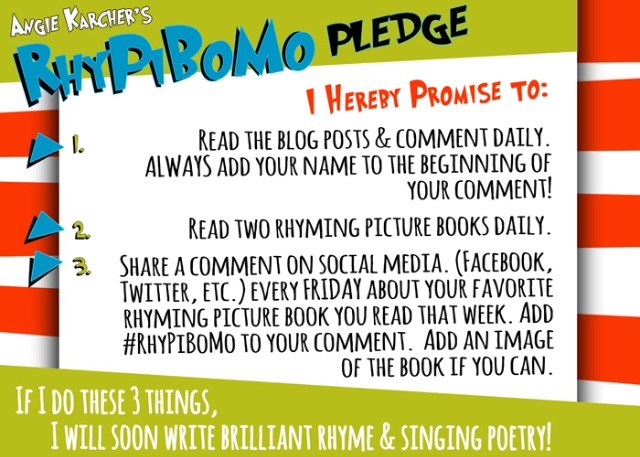
Please follow the pledge rules daily to get the most out of this challenge!
The drawings will be done daily and announced on Saturday of each week.
 Angie Karcher
Thanks for the advice, i never use mono-syllabic words but it was helpful to get a reminder of figures of speech, long since placed in the dark recesses of my mind.
Thank you Sally for sharing the complexities of rhyme. – Judy Rubin
They say that obvious rhymes for “cat”
Are “rat” and “that” and “sat” and “hat”.
But if that rat sat under the hat,
It’s certainly not obvious to the cat!
(Sorry, couldn’t resist… 🙂
Melinda Kinsman – Thanks for an interesting post, Sally. And thanks for the great “Figures of speech” summary. I know I need to include a lot more of these in my own rhyming, but I hadn’t yet made myself a summary of what all the words actually mean!
Stephanie Salkin
Sally, you chose my favorite poem in the world with which to make your point.
The opening rhyme of my latest manuscript has three syllables so I guess I’m on the right track. Thanks for a very useful post, Sally! — Rebecca Colby
Linda Schueler: It’s the first time I’ve seen phlegm and gem rhymed. And yes, let’s strive for fewer advertising jingles.
Natalie McNee
Thanks for the info Sally and thanks for the links to your courses, I’m checking them out now 🙂
Mona Pease
Thanks, Sally. I’m glad I met you last summer because I can hear you and see your never ending smile as I read this post. Saliva and phlegm…yuck!!!(as you smile louder!!)
Many thanks Sally for the wonderful tips and reminders! I am inspired today! Great post!
Arin Wensley
I want to give great thanks for this post on the use of multi-syllabic words in our writing. Thank you so much, I know I need a lot of help in this area. Wonderful post!
Great post…. Sally I loved the advice regarding how to make your rhyme roll.
Anne Bielby — Going to take a good look at my rhyming manuscripts and see where I stand re your post. Thanks!
Sally, Thank you for sharing your “multi-syllabic rhymes.” I agree that syllabic is an odd sounding word. And rhyming PBs should be a joy to read aloud. Manju Howard
Thank you, Sally. I was struggling with multi-syllabic rhymes yesterday. Often it is difficult to find ones that young readers will understand.
MaryLee Flannigan – Thank you Sally for your advice on multi-syllabic rhymes. Lots to think about.
Thanks Sally! 🙂 It’s one thing to understand a concept intellectually but your post help me feel it as well. 🙂
Daryl Gottier: Thanks for the helpful post full of great examples.
Jen Garthe — I’ve been thinking a lot about multisyllabic rhyming, inspired in part by Josh Funk’s use of “linguini” and “avalanche” as end rhymes in Lady Pancake and Sir French Toast. Makes the story much more entertaining and powerful! 🙂
Joana Pastro
Wow! You did “delight the ear and stir the soul” with your post.
Thank you so much for this amazing post!
Thank you so much, Sally, for your informative post. I will be looking a lot more closely at my work!
Pat Haapaniemi
Kristi Veitenheimer – Always love to read any writing advice that Sally offers! You can be sure that it will be full of useful tidbits and lots of funny wit, lol! I was blessed to meet both Sally and Angie at a writing retreat last summer. Fine ladies they are. Love today’s post!
Thank you for your post, Sally. The link to Figures of Speech is a handy dandy resource to keep next to your computer–even if you were sure you knew all of them all before. I wasn’t aware of how often I use one-syllable words in my manuscripts, but boy, I sure will be now! =]
Debbie Smart –
Thank you, Sally, for such an insightful post. I truly appreciate the examples you shared with us. Thanks again!
Kathy Mazurowski
Thanks for the examples. I needed this today.
Gayle C. Krause
Sally, you give great advice to make a story more interesting. I’m assuming you mean only a few examples of three syllable rhyming words in a piece, yes? Every line ending in multi-syllabic would be quite a feat! 🙂
David McMullin. Thanks, Sally. I love being pushed to work harder.
Ann Kelley What great advice and reminders to write what pulls the heart!
Lynne Marie (LiterallyLynneMarie@Gmail.com) So helpful, Sally and Angie – thanks so much!
To make sure you don’t leave our Sal in perplexity, send her your stories that rhyme with complexity.
Not preachy, not teachy, in no way didactic- keep your words fresh, tense, not anticlimactic.
un-rhyming multi-syllabic:
A hoity-toity boor
full o’ malarky ‘n shenanigans
met his whirlygig nincompoop
in cahoots with a topsy-turvy ragamuffin
busy as a one armed coat hanger
on a cockamamie doohickey
of a hodgepodge afternoon.
Before sunset,
the scalawag skedaddled off
with his pipsqueak
for a roly-poly overnighter
of razzmatazz ramshackle razzle-dazzle!
by Jeanne Poland
Thanks for the great advice and clear examples, Sally. Cindy Williams Schrauben
Sally’s words are marvelous.
Stories must be fabulous
Words must sing and pirouette.
Or you’ll be easy to forget!
Great article. Thanks.
Tim Canny – Great advice with great examples. I also liked reading Sally’s submission guidelines, though I’m some work away from submitting anything. 🙂 Also, how bad is that I had to look up “anaphora”? Asking for a friend!
Sally,thank you for an inspiring blog today and lots of good advice. I particularly liked it that you look for a Christian point of view but NOT preachy. I also liked what you wrote about poetry. That’s the hard work we need to uncover and then we might discover
the joys of jostling words about to give them more printable clout!
“But really what you need to do is delight the ear and stir the soul if you want to break in with your picture books.”
Thanks so much and blessings,Jane
Joy Main – Thanks Sally. I looked up anaphora too, and also found out about cataphora, which is a brilliant word for a picture book so it needs a new meaning! You learn a new thing every day….
Thank you, Sally, your post was very helpful!
Judy Sobanski – Sally, thanks for sharing your thoughts on rhyming picture books. I love that you challenge us writers to work beyond creating just simple rhymes.
Debbie McCue
Thanks for emphasizing the need for choosing words that add interest in sound and “stir the soul”, for introducing me to a lovely poem, and for providing the link to “Figures of Speech”.
I won’t forget your great advice and I’m up for the challenge!
Kristen Foote
Great insight and helpful examples!! Thank you so much for your post!
Melanie Ellsworth – What a rich post! Thank you, Sally. The list of poetic devices is very helpful, and I’ll enjoy exploring your website further.
susan schade
Writing in Rhyme-Delight the ear and stir the soul.
Words that will stick with me.
Thank you!
Melissa Stoller —
Thanks for a great post with beautiful examples!
Jill Giesbrecht – I learned a new word – anaphora! Thanks for sharing your expertise with us.
(Katelyn Aronson) Thank you, Sally! It’s so nice to hear from an agent who knows her rhyme and who welcomes rhyming picture books when they’re done well.
Great post Sally! It’s so important to have complex, lyrical and beautiful language within those rhyming picture book manuscripts. Our young readers are pretty discerning and recognize a good rhyming story when they hear one! Thanks, Patti Richards, pgwrites5@gmail.com
Thanks, Sally!
This is enough food for thought to keep us chewing for a while. That’s the best explanation of why one syllable rhymes don’t work that I’ve heard, and a perfect poetic reference to illustrate the point. Thanks for a great post! Sherry Howard
Shelley Kinder
Some REALLY good information here, Sally! Thank you. My last rhyming story had a bambino/Valentino rhyme, so I’m feeling pretty good about that after reading your post…LOL. I love what you said about looking for books written from a Christian worldview, but aimed at the general market. I see that your website says you are looking mainly for author/illustrators. Wish I could draw! Thank you again…really enjoyed this!
Tanja Bauerle
Hi Sally, Thank you for your splendid post and for clarifying that “easy and quick” rhyme is not strong enough to make it in the publishing world. Devoting the time to craft the best possible manuscript is essential to catch the eye of editors and agents. Great wisdom. Sending you oodles of hugs and smooches. 🙂 It was so wonderful to meet you last Summer. More coming soon. 🙂 T