

The Story Book Knight
Written and Illustrated by
Helen and Thomas Docherty
2016 Best in Rhyme Award Top 10
Congratulations Helen and Thomas!
See the Top 20 Best in Rhyme Books for 2016

Rhyme Schemes
By Helen Docherty, author of The Snatchabook
and The Storybook Knight
I’m going to start with a confession: I never actually set out to write in rhyme. The first stories I wrote were in prose. But when the idea for The Snatchabook came to me – and it came pretty much fully formed – the story itself seemed to dictate that it should be written in verse. I knew that I had to create an atmosphere of suspense and mystery, and to draw the reader in from the very beginning of the story. Writing in rhyme seemed an effective and natural way to achieve this.

One dark, dark night in Burrow Down,
A rabbit called Eliza Brown
Found a book and settled down…
When a Snatchabook flew into town.
This opening 4-line stanza is written in monorhyme (the last word in each line rhyming with all the other last words) for a specific purpose; to foreshadow the events of the story and to link the two main characters, Eliza and the Snatchabook (who will, of course, eventually become friends). The first and fourth lines introduce an element of suspense, suggesting to the reader that something scary is about to happen. The middle two lines, in contrast, present an image of cosy domesticity; however, the fact that they are enclosed by the first and fourth lines warns us that Eliza’s bedtime routine is about to be disrupted. Monorhyme should, in general, be used sparingly (to avoid becoming tedious), but it can be an effective device in the right place.
The rest of The Snatchabook follows the more conventional AABB rhyme scheme:
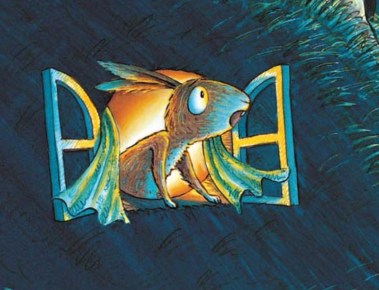
In every house, in every bed,
A bedtime book was being read.
Tales of dragons, spitting flames;
Witches, playing spooky games;
Pirates, on the seven seas;
Princesses, trying to sleep on peas.
From a personal perspective, I find this rhyme scheme (and meter) quite lulling – suitable for a bedtime story. It seems to encourage a slow reading, with each line being savoured. Of course, the pace can be upped for moments of high drama:
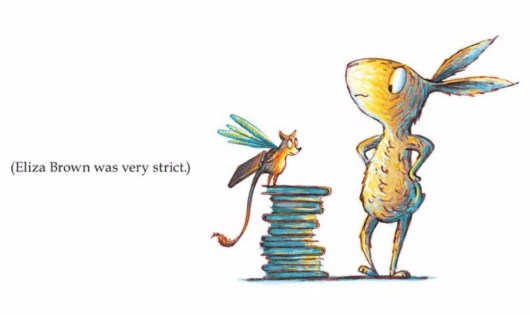
She threw the window open wide
And shouted to the Thing outside:
“Stop stealing all our books, right now!
Just give them back, I don’t care how!”
Within the constraints of a rhyme scheme, you can always try to surprise the reader with an unexpected rhyme. For example:
[And so, the Snatchabook began]
To give back all the books he’d picked.
Eliza Brown was very strict.
Incidentally, in the original (UK) version, I’d used ‘nicked’ – a colloquial British term for stolen – rather than ‘picked.’ Some words get (literally) lost in translation!
The Storybook Knight (which was in the 2016 Best in Rhyme Top 10 List) employs a different rhyme scheme (ABAB, or alternate rhyme):
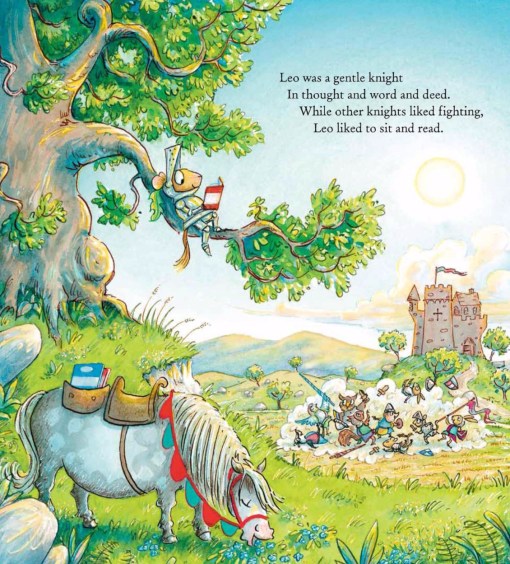
Leo was a gentle knight
In thought and word and deed.
While other knights liked fighting,
Leo liked to sit and read.
I find this rhyme scheme more conversational and a little jauntier than AABB, so it felt more suitable for the story of Leo, forced to undertake a quest by his pushy parents. I particularly like the way that the final rhyme in each 4-line stanza can deliver a punchline, or subtly subvert the rest of the verse:
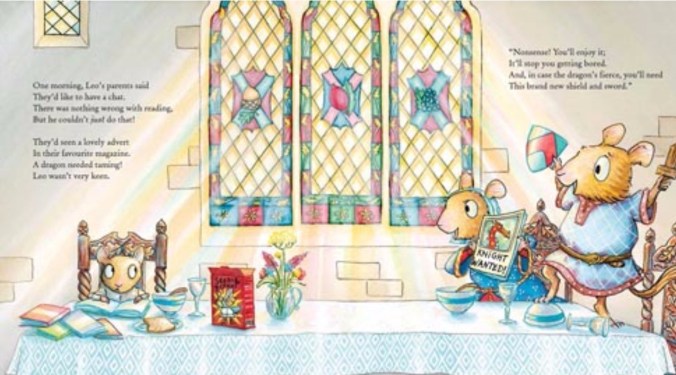
One morning, Leo’s parents said
They’d like to have a chat.
There was nothing wrong with reading,
But he couldn’t just do that!
They’d seen an ad that morning
In their favorite magazine.
A dragon needed taming!
Leo wasn’t very keen.
When I start writing a new story, there is often a particular rhyme (and not necessarily the first) that comes into my head, and which then dictates the rhyme scheme of the book. For example, when I had the idea for Abracazebra, the story of a goat who is jealous of the zebra who arrives in his sleepy village and starts performing magic shows (to everyone else’s delight), I started with just two lines:
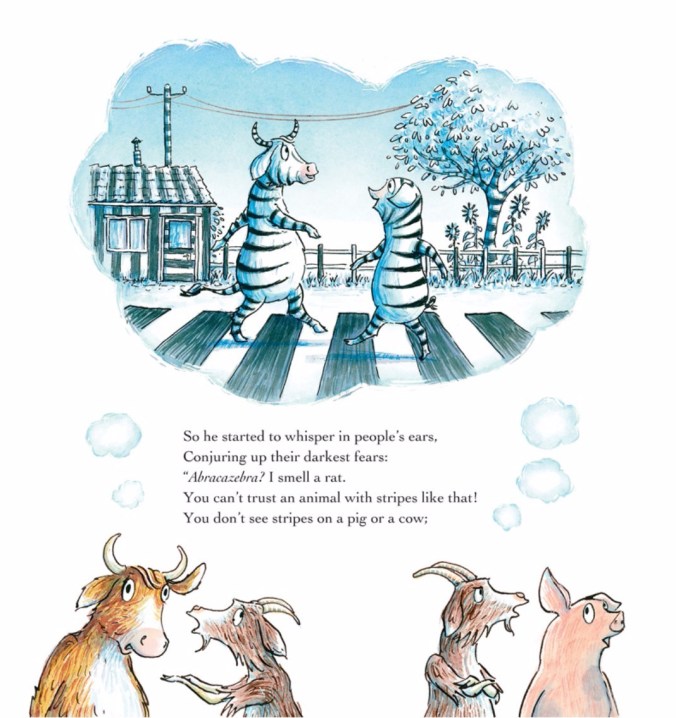
Abracazebra? I smell a rat.
You can’t trust an animal with stripes like that!
As the story took shape, new lines grew around the original two, which actually come about two thirds of the way through the story:
So he started to whisper in people’s ears,
Conjuring up their darkest fears:
“Abracazebra? I smell a rat.
You can’t trust an animal with stripes like that!
You don’t see stripes on a pig or a cow…
…So why should we welcome stripes here now?”
Like The Snatchabook, Abracazebra follows the AABB rhyme scheme, but with more syllables in each line. Sometimes, it can be fun to add a twist to a rhyme scheme. My latest rhyming story, You Can Never Run Out of Love (out September 2017) is written in a simple ABAB rhyme scheme, but with a refrain that follows a different pattern, with an internal rhyme (call it CCD). Here is an example:

You can run out of time.
You can run out money.
You can run out of patience,
When things don’t seem funny.
BUT…
You can never (no never, not ever)
You can never run out of LOVE.
By breaking with the original rhyme scheme and introducing a refrain, the central message of the story is reinforced, and the key word (love) is given its own, un-rhymed status. When reading the story aloud to elementary school children, I’ve found that they naturally join in, saying the word ‘love’ at the end of each refrain; and I think that the rhyme scheme encourages them to do this.
Finding the right rhyme scheme for each story can be tricky, but it’s also fun and ultimately satisfying, as is finding the right words to rhyme. Good luck if you are writing your own rhyming story!


Before becoming an author, Helen used to teach Spanish and French. She also has an MA in Film and Television Production. Helen has lived and worked in France, Spain, Cuba and Mexico, and now lives in Swansea, Wales, with her husband, the author and illustrator Thomas Docherty, and their two daughters.
Her first rhyming story, The Snatchabook (illustrated by Thomas Docherty), has been translated into 17 languages. In 2014 it won an award voted for by school children. It has also been staged as a play and even as an opera, by a school in Canada.
The Storybook Knight (2016) is Helen and Thomas’s latest book together. Helen’s next rhyming story, You Can Never Run Out of Love (illustrated by Ali Pye), is coming out in September 2017.
Website: www.helendocherty.com
Twitter: @docherty_helen
Facebook: @HelenDochertyAuthor
To participate in Rhyme Revolution:
Read the blog post and comment below
to be eligible for a prize.

Congratulations
Week 3 Prize Winners

Monday – Patti Richards – GOOD NIGHT, BADDIES by Deborah Underwood
Tuesday – September Cardiff – LEONARD’S BEARD by Nancy Cote
Wednesday – Mary Warth – THE RHINO WHO SWALLOWED A STORM by LeVar Burton and Susan Schaefer Bernardo
Thursday – Susan Schade – ROCK-A-BYE ROMP by Linda Ashman
Friday – Linda Evans Hofke – SUN KISSES, MOON HUGS by Susan Schaefer Bernardo
Thank you for reading the blog posts and commenting daily!!
I will stick these in the mail next week. I have your addresses via registration.
Thank you to the authors and publishers
for these generous book donations!!
 Angie Karcher
What great books to look at the rhyme schemes and meter! And, in each, story first!
I’ve always loved the way The Snatchabook was written. Can’t wait to read your other stories. They sound wonderful. Great post on rhyme scheme! Thanks, Helen!
Great examples of how rhyme schemes can create the mood of the story. The Snatchabook is such a fun read. Thank you for this blog Helen!
Thanks for your post! I’m a fan of The Snatchabook. I was drawn into the story from the first sentence. And the illustrations blend perfectly.
I’m guessing your talent & experience with (foreign) languages add to your Rhyme IQ. Nice explanation of how different rhyme schemes convey various tones/voice. Thanks!
Thank you for your post with your examples of rhyme patterns and meter. I have your two books and will look for your others. They are favorites.
I enjoyed learning your process of choosing the right rhyming scheme for each of your books. Thank you for sharing and I look forward to reading your new stories!
So interesting to learn how to use rhyme to set the mood for a story. I love The Snatchabook, and can’t wait to read your other books. Thanks, Helen!
Thank you Helen!!!
Wonderful examples from wonderful books!!!!
Lovely post with your picture book examples. Thank you for your scheme reviews and reminder that each story may call for a different one. Your husbands illustrations are beautiful.
You are truly a master rhymer! Congrats on such fabulous books and I can’t wait to read your new one -sounds very sweet!
I own the snatchabook! I love the story and rhythym. thanks for a great post!
I feel like I’ve really been to rhyme school this morning! Thank you, Helen, for all the examples of rhyme scheme and where to use them. I’ll be coming back to this one again and again. And thank you, Angie! I can’t believe I won a book! I never win anything! Maybe this means my luck is changing:)
Patti Richards
Reblogged this on Sensibility and Sense and commented:
Helen Docherty, author of The Snatchabook and many others, talk about rhyme scheme and how to use it to set the mood and pacing in your stories. Another great post in Angie Karcher’s Rhyme Revolution!
Thank you for the wonderful post!
I had a non-rhyming refrain in my rhyming PB and took it out…but now I’m thinking it might work. Thanks, Helen, for the great examples!
Helen, I LOVE your books. This new one sounds delightful. Snatchabook is one of my all-time favorites. I appreciate your breakdown of the rhyme and how you developed it for these books. thank you very much.
Thank you, Helen, for sharing how different rhyme & meter schemes further your stories. The examples are so helpful!
helen,
I am very impressed with your knowledge and rhyming smarts. i plan to read all of your books. Do you ever give critiques or online courses?
For someone who didn’t start out wanting to write in rhyme, Helen Docherty certainly made a bang-up job of it! As one who DID start out wanting to write in rhyme (and has long been doing so), my hat is humbly off to Helen! I think I gotta have this book!
Thank you, Helen, for sharing your process of selecting the right rhyme schemes for your books. Voice, mood, and tone delivered so cleverly-love it! I look forward to your new story coming in September!
I own The Snatchabook – one of my favorites!
Helen, thank you for a great post on rhyme schemes and
your process.
I love your creative ideas and rhyme schemes, Helen. Such fun books!
Thank you so much for sharing your thoughts on rhyme. I absolutely love The Snatchabook! It is one of my favorites.
Yes, finding the right rhyme scheme is certainly a tricky business…still working on it….
Thank you for the wonderful analysis of your rhyming techniques and they create the perfect book.
Another great post. And cute characters!
Helen, I love your rhyming picture books and look forward to reading your newest one! Thank you for sharing the reasons behind your choices of rhyming schemes for your books. Great tips to keep in mind when working on my own stories.
This post is a great reminder that not only do we need to perfect our rhythm and rhyme for children’s books but also pick a rhyme scheme/word flow that fits the story. Thanks!
and WOW! I won a book!!!! I can’t wait to receive SUN KISSES, MOON HUGS by Susan Schaefer Bernardo. I don’t have this one yet and it sounds perfect for my family. THANK YOU!
Great stories and unique look at rhyming. Thanks for your post. Best of luck with your book in September.
Thank you for sharing, I’ll now be comparing my rhyming schemes with story themes!
I love each of these stories. Amazing creativity. Thanks for sharing some of your process with us. I read The Snatchabook earlier, I think it was on a list for REFOREMO last year. So nice to “meet” the book’s author.
I love your examples! The explanations really help me to see they rhyming rhythm and function each type provides. Thanks so much for sharing with us. Congratulations!!!
Congratulations to the Week 3 prize winners! Thank you for your post, Helen. I hadn’t heard of the term monorhyme before. I will return to my local library here in Bathurst, Australia, to re-borrow The Snatchabook and The Storybook Knight to delve deeper into the workings of the rhymes.
Update: The library version of The Snatchabook has ‘nicked’ in it so it’s the UK version as is The Knight Who Wouldn’t Fight.
Oh, this is rich–a snatchabook!
How how can a person catchacrook?
Oh these are wonderful!! Each year our school has a literacy program called, Reading Under the Stars. It’s where each class choose a special picture book to perform outdoors, you guessed it, under the stars. Last year, my class did the Gruffalo. Now I have some fabulous titles to introduce and have my students choose. Oh thank you, thank you for this post. Wonderful resource.
Several of my rhyming pieces come to me by way of a couplet that later ends up in the middle of the manuscript. It’s fun to build the arc from the middle out sometimes! Thanks for sharing all of your reflections with us!
HELEN: I ABSOLUTELY ADORE The Snatchabook, and CAN’T WAIT to read The Storybook Knight! LOVE YOUR IDEAS! LOVE YOUR WRITING STYLE!!! THANK YOU for this WONDERFULLY INSPIRING post!!!
Thanks for the lesson in rhyme scheme…and I LOVE Snatchabook.
I absolutely loved The Storybook Knight. It was exactly the kind of book I’d have wanted as a child. Wait! I am still a child…at heart! In any case, thank you for sharing. 🙂
Helen – thanks for your post – I will be saving it to read again! I look forward to reading your upcoming book.
Helen, thank-you for your informative post. I enjoyed reading your thoughts on the techniques and rhyming schemes you used in your books. I adore SNATCHABOOK. It is definitely one of my favorite picture books. I can’t wait to read the others you mentioned. The bits I got to read are delightful. I know they will become great mentor texts for me to study.
Congrats to all the prize winners! And thank you very much for the great book!
I really appreciated this post. The examples are very helpful and inspiring.
Love all your books, Helen! Thanks for the great post.
Thank you for your explanation of how different rhyme schemes reveal the voice and tone of a story. I’m new to rhyming and am learning so much from the mentor texts and posts.
I love all your examples and look forward to reading your books! Thank you for your post.
Such as an informative post! The examples are so helpful to me. I love your stories! Thank you, Helen!
I’ve did that in my manuscripts before, too. I think it sounds good that way.
These are fantastic examples of why you chose the rhyme you did. Thank you so much.
Your rhymes are such a pleasure to read:) Thanks, Helen!