Happy Tuesday!
Rhyming Critique Groups will be organized this week!
Thank you Dawn Young for organizing our rhyming critique groups again this year! Dawn posted a sign up on our Facebook page so please sign up there if you want to join a rhyming critique group! You MUST be on the RhyPiBoMo Official Registration List to participate this year as we have so many people to accommodate. This is a great opportunity to find other rhymers, as it’s tough to find a rhyming crit group.

I am so pleased to have today’s guest blogger. She is a partner in crime with the rhyming guru Corey Rosen Schwartz. Together they wrote the Best in Rhyme Honor Book WHAT ABOUT MOOSE? If you haven’t read it, find it! It is a delightful read and a perfect example of how rhyme enhances a story.
I’m pleased to introduce
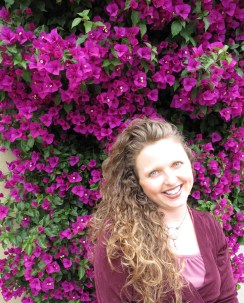
Author Rebecca J. Gomez
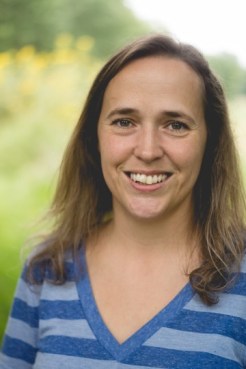
Author Rebecca J. Gomez
Avoiding Disaster: Consistency in
Rhyme and Meter
When someone picks up a rhyming book, they want it to shine. They want the rhymes to be true and the meter to flow smoothly. Anything less can mean disaster for your story.
Do you want to avoid disaster in your rhyming manuscripts? Here are a few things to keep in mind:
-
Syllables aren’t everything.
More important than the number of syllables is a word’s natural rhythm. Consider the word “coincidence.” Four distinct syllables in a clear, established, natural rhythm—co-IN-ci-dence.
Others don’t have such consistent rhythm. Consider wild, fowl, and rumbling. The rhythm in each of these words depends on the speaker.
Wild and fowl technically have one syllable each. But many people, like me, pronounce them as two. Wi-ld. Fow-l.
Rumbling may seem like an obvious three-syllable word. But not so fast! Sure, rumble is two, so adding “ing” to the end would make it three. Right? Not necessarily. Some people skip over that middle syllable and pronounce the word as two. Rumb-ling.
Alternate pronunciations can also affect a word’s natural rhythm. Consider the word “harassment,” for example. Is the stress on the first or second syllable? It depends on the speaker.
-
Does it REALLY rhyme?
When my co-author, Corey Rosen Schwartz, and I are working on a rhyming manuscript, one of us will inevitably say, “Those words don’t rhyme.” I’m in the Midwest. She’s on the east coast. We talk differently. For me, the words not and thought rhyme perfectly. For her, they don’t.
Working these things out together has helped us write rhyming stories with consistent, easy-to-read rhyme and meter.
-
Names and verbs often compete for the stressed beat.
Consider this sentence: Jack ran down the street. Now say it out loud. Did you emphasize Jack or ran? I tend to emphasize a name when it is the first word in a line, but others will emphasize the verb. If I came across a section of verse like the example below, I might need to pause and correct myself.
Jack ran down the street
with no shoes on his feet,
feeling anxious to meet
his best friend.
This won’t be an issue for every reader, but it’s your responsibility to be aware of even the slightest potential for meter trouble and take steps to address it.
-
If it doesn’t fit, don’t force it.
Don’t arrange a line in such a way as to force an emphasis onto a different part of a word. This is a big NO-NO and I doubt your readers will forgive you for it (assuming a mistake like this makes it past an editor…which, sadly, does occasionally happen).
Don’t use a word solely for its rhyme. Just because a word is listed on thesaurus.com as a synonym – and it’s just the rhyme you need! – doesn’t mean you should use it. Would you use that word if you were writing in prose? Does it truly make sense in the context of your story? Readers love interesting language, but if it a word feels out of place, it will annoy rather than amaze.
Because of the differences in the way people talk, the way they read, and even their penchant (or lack thereof) for rhyme, consistency in rhyme and meter is difficult to attain. However, if you put in the effort and are more patient than you ever thought possible, then your story’s “meter issues” will be blips rather than disasters.
Bio:
Rebecca J. Gomez loves to write rhyming stories and poems because they are her favorite to read aloud. When she’s not writing or test-reading her rhyming manuscripts on her family, she likes to bake, crochet, hike in the woods, watch movies, and read books from her ever growing to-read pile. She lives in Nebraska with her husband, three kids, two poodles, and one parrotlet.
Thank You Rebecca!
PLEASE like our guest bloggers on Facebook, follow them on Twitter, go to their websites and express your appreciation for their time and wisdom! Many have generously donated multiple prizes and this event would not be successful without their support, so please support them! Oh…and buy their books too!!

To be eligible for today’s prize drawing by Random.org you must comment at the bottom of the page where it says “Leave A Reply” AND add your FIRST and LAST name in the comment. If I don’t have your name or how to contact you via email, you can’t win.
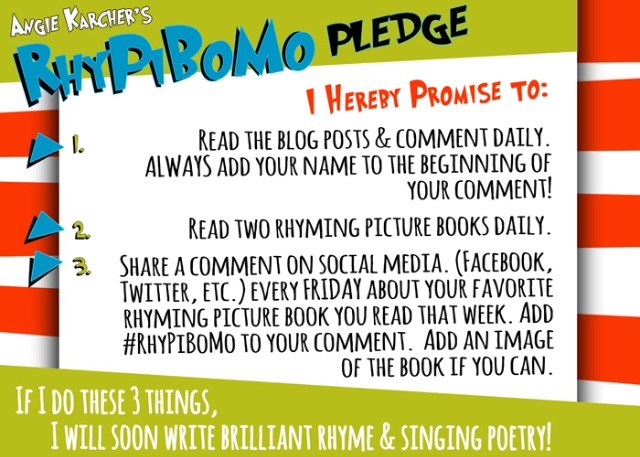
Please follow the pledge rules daily to get the most out of this challenge!
The drawings will be done daily and announced on following Monday of each week.

 Author Linda Sue Park































 Angie Karcher