It’s Sunday, the day for our
Rhyming Party today at Noon, Central Time!
Go to the
RhyPiBoMo Facebook Group
to join the fun!
*
*
Announcing this weeks daily prize winners!
Don’t forget to comment EACH day that you participate in order to be eligible for the week’s prizes. You have until Midnight on Saturday each week to get caught up for the week. There were several people who would have won a prize that commented but are not registered for the event. You must be registered to qualify for a prize! Click the registration tab above or go to https://angiekarcher.wordpress.com/rhypibomo-registration/and register now!
*
*
This week’s Daily Prize winners are:
Sunday Kevan Atteberry Art quality signed print of his rhyme cartoon Penny Parker Klostermann
Monday Bear Feels Scared by Karma Wilson Charlotte Dixon
Tuesday Who Goes There? by Karma Wilson Cecilia Clark
Wednesday Choice of Noodle & Lou, Think Big or Happy Birthday
Bunny by Liz Garton Scanlon Lori Mozdzierz
Thursday Beetle Bop by Denise Fleming Helen Dening
Friday 2 Hour Manuscript Edit by Jackie Hosking Jennifer B. Young
Saturday underGROUND BY Denise Fleming Jill Proctor
WINNERS: EMAIL me at
Angie.karcher@yahoo.com
with your mailing addresses to receive your prize!
~~~~~~~~~~~~~~~~~~~~~~~~~~~~~~~~~~~~~~~~~~~~~~~~~~~~~~~~~~~~~~~~~~~~~~~~~~~~~~~~~~~~~~~~~~~~~~~~~~~~~~~~~~~
As our Daily Lesson is on stanzas today, I thought I’d share a Stanza Riddle!
*
Who is tall, dark and handsome and puts up with a children’s author who…
*
Writes all night and sleeps all day,
forgets to make dinner but write this buffet?
He doesn’t complain or ever ask why,
my husband Stan-za really great guy!
*

Mardi Gras 2013
Thank you Stan Karcher for putting up with my shenanigans! I love you!
Happy Birthday on April 23rd! I’m telling you early in case I forget in all my RhyPiBoMo mania! = )
*
*
Fortunately, you can’t see how messy my office has become in one short week, strewn with picture books, rhyming dictionaries, and empty coffee mugs, but look what came in the mail Yesterday! I finally got my copy of GOOD BYE, BAD BYE. It is a delight! This newly released rhyming picture book is a gem, combining Deborah’s thrifty yet brilliant text and Jonathan Bean’s amazing illustrations.

“Bad truck, bad guy; bad wave, bad bye . . .” A boy and his family are packing up their old home, and the morning feels scary and sad. But when he arrives at his new home, an evening of good byes awaits: bye to new friends, bye to glowing fireflies, bye to climbing trees. Happy Book Birthday month to BAD BYE, GOOD BYE!
*
*
So, without further ado, I’m honored to present today’s
Golden Quill Guest Blogger
Deborah Underwood
*
*


*
*
*
How’s Your Verse Sense?
You may know people whose poetic efforts are impeccable. Their rhymes are natural, not forced; they don’t use convoluted syntax (like “the box unopened underneath her bed she put”); their words skip along, effortlessly conforming to the metrical structure they’ve set up.
*
You may also know otherwise-excellent writers who repeatedly bring subpar rhyming manuscripts to critique meetings. The rhymes are forced. Some lines are missing a foot (or two or three). The metrical pattern changes randomly from stanza to stanza.
*
What do the former folks have that the latter folks lack? I call it verse sense: the ability to tell good verse from bad.
*
Like any writing skill or asset, verse sense comes naturally to some. I feel fortunate in that it’s pretty easy for me to hear when rhyme doesn’t work. Writing descriptive passages, though? I am terrible at that. Terrible!
*
Does this mean that if I yearn to write a description-filled novel, I shouldn’t try it? Of course not. But I’ll have an extra hurdle, because my natural description ability is nonexistent. I’ll need to work my tail off to compensate.
*
You can probably see where I’m going with this.
*
You’ve heard a million times how biased editors are against rhyming manuscripts. That’s because they’ve seen so many bad ones. And does any writer think she’s submitting a bad rhyming manuscript? Of course not!
*
Thus, the bad manuscripts are submitted by people who 1) don’t have natural verse sense and 2) don’t know that they lack it.
*
That last bit is important. Because if you know you don’t have verse sense, you can acquire it through study and practice. You can:
*
*
– Learn about poetic forms in more detail. (Participating in RhyPiBoMo is a great place to start!)
– Analyze your rhyme beat by beat, marking stressed and unstressed syllables and counting feet in each line.
– Rely on writing friends who do have an ear for rhyme.
– Comb through your work to eliminate syntactical contortions.
– Read all the fabulous rhyming picture books you can get your hands on. (Read some bad ones too and figure out why they don’t work!)
– Surround yourself with good rhyme of all kinds. One of my favorite non-kidlit sources: the works of Gilbert & Sullivan. I was a huge fan of The Mikado when I was in grade school, and I attribute some of my rhyme affinity to my early fascination with and delight in that operetta’s clever libretto.
*
Basically, you must do whatever you need to do to make your rhyming manuscripts very, very good. Because that is what they need to be–for your own sake, so you can get them published, and for the sake of the kids who will read them.
*
So where are you on the verse sense spectrum? Are you certain you’re rhyme-savvy, because many friends you trust have told you that? Are you so-so? Do you suspect that you don’t have a natural affinity for rhyme?
*
An honest assessment, with the help of trusted critique pals, will help you plan your next steps. Then onward to rhyming glory!
*
*
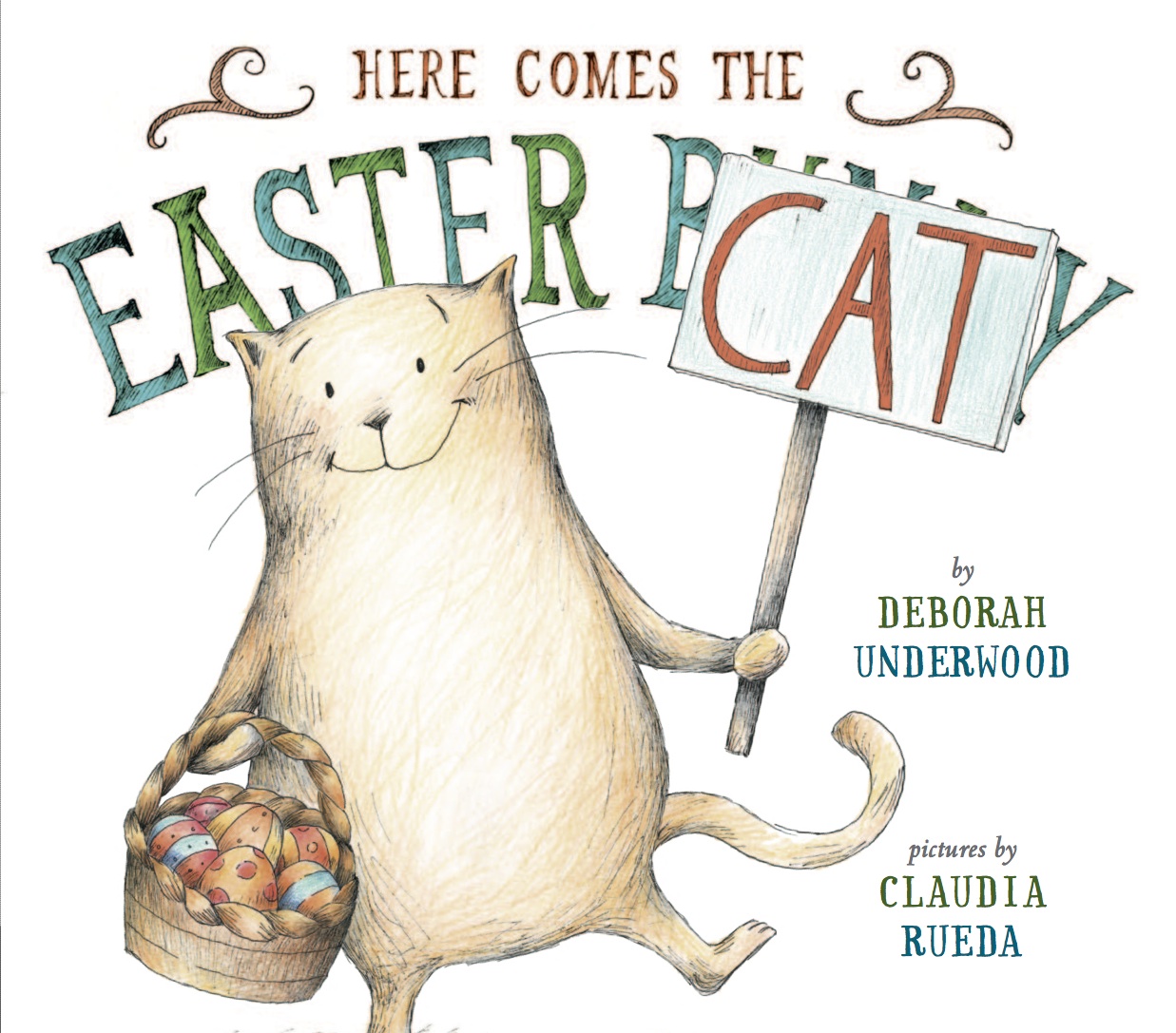
Two of Deborah’s Latest books:
*
*

*
*
*
Deborah is the author of the following children’s books:
The Loud Book (Houghton Mifflin, 2011)
The Quiet Book (Houghton Mifflin, 2010)
A Balloon for Isabel (Greenwillow Books, 2010)
Granny Gomez & Jigsaw (Disney*Hyperion, 2010)
Pirate Mom (Random House, 2006)
She writes the Sugar Plum Ballerina chapter book series with Whoopi Goldberg.
She’ s written numerous nonfiction books for educational publishers. Her poems, articles, and stories have been published in National Geographic Kids, Spider, Ladybug, Pockets, and other children’s magazines. She has also been hired by educational publishers to write leveled science books, phonics readers, testing passages, and test questions.
Thank You Deborah Underwood!
~~~~~~~~~~~~~~~~~~~~~~~~~~~~~~~~~~~~~~~~~~~~~~~~~~~~~~~~~~~~~~~~~~~~~~~~~~~~~~~~~~~~~~~~~~~~~~~~~~~~~~~~~~~~
RhyPiBoMo Daily Lesson: Sunday, April 6th
By Angie Karcher © 2014
Lesson 8
*
*
Stanza
A Stanza is a rhyming pattern in poetry that forms a group. (write this down)
A stanza can have any number of lines. These groups of lines are given specific names.
Usually there is a blank line between stanzas to separate them.
The different verses in music are stanzas.
*
I listed these yesterday but we will go into more detail now…
*
*
Special names of stanzas depending on the number of lines:
*
2 lines – Couplet
3 lines – Tercet
4 lines – Quatrain
5 lines – Quintet
6 lines – Sestet
7 lines – Septet
8 lines – Octave
9 lines – Nine-line stanza
10 line – Ten-line stanza etc…
*
Couplets, tercets and quatrains are the foundation of poetry! (write this down)
*
*
Couplet – A 2 line stanza with end words that rhyme.
For example:
I want to climb the tree so high
And reach to touch the cloudy sky
*
Tercet – A 3 line stanza with end words that rhyme.
For example:
When walking down the gravel road
I spied a slimy, greenish toad.
He jumped into in his wet abode.
*
Quatrain – A 4 line stanza with a variety of rhyme schemes.
The most common rhyme scheme for a quatrain is where lines 2 and 4 rhyme.
*
For example:
I see while sitting in the grass
and counting sheep by twos.
Two, four, six, yes eight of them
are really full-grown ewes.
*
How could I get through this post without mentioning
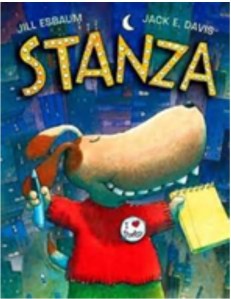
Jill Esbaum’s adorable rhyming picture book titled
STANZA…
*
 *
*

Stanza is a closet poet who secretly enters a poetry contest. He’s hoping to win first prize, fame, fortune and Lotsa snapper treats.
*My favorite two lines are “he’s itching to write” and “he’s doggone depressed”
It’s such a delight and the meter is Stantastic!
*
*
Here are other variations of quatrain rhyme scheme.
For example:
ABAB
I ate the chip.
It made me want
to do a flip;
a silly stunt!
*
For example:
AABB uses two couplets
The apple is a yummy snack
to eat while sitting on a yack.
Remember, though, to share a bite
This will prevent a yack-snack fight.
*
For example:
AAAB
My brother is always annoying and loud.
My mother believes that his head’s in a cloud.
He really embarrasses me in a crowd.
I wish he would just go to sleep.For example:
*
AABA
A pickle is crunchy when you take a bite.
The noise is so loud, I think that it might
cause mountains to topple and elm trees to fall.
This is a good reason for pickle-bite fright!
*
ABBA this is called an envelope verse, the middle rhyme is enveloped by the outer rhymes.
Word on the street is it’s going to rain.
I’m a sad fella,
sans my umbrella.
I am preparing to get wet again!
*
Longer stanzas are made up of various combinations of the couplet, tercet and quatrain.
*
*
There are obviously many combinations that can be used in different stanzas. One I came across is called a Spenserian stanza. It was invented by Edmund Spenser. Each stanza contains nine lines in total: eight lines in iambic pentameter followed by a single ‘alexandrine’ line in iambic hexameter. The rhyme scheme of these lines is “ababbcbcc.” Whew! That’s quite a poetry puzzle! I dare you… LOL
*
*
Resources:
http://examples.yourdictionary.com/stanza-examples.html
http://www.mrdaley.com/wordpress/poetry/stanza/
*
*
Writing Prompt: Write what appeals to you with the examples above. Writing the AABA and the AAAB were the most fun for me!
*
*
*
Okay, now do everything else on the pledge for today and don’t forget to comment on today’s blog post!

RhyPiBoMo Pledge
Please comment ONLY ONE TIME below for a chance to win today’s prize!
Prizes will be drawn by Random.com next Sunday for the previous week.
To be eligible for a prize you must be a registered participant and
comment after each days lessons.
 Angie Karcher
My goal is to try different rhyme schemes other than the couplet! 🙂
Thanks for the post, Angie! I look forward to reading Stanza!
I, most frequently, use AABB or ABAB. 🙂 I majored in English Lit. and one of my courses was poetry – studying the greats and writing my own – so I’ve written every style of poem imaginable, but my go-to poem styles are the most basic.
Angie,
You put so much into each day’s post. I can see how you might overlook something at home. I’m so glad I heard about your this special month of events here. Thanks for all you do.
Thanks Angie, another great post. I am swimming hard to keep up with it all and practice each day. I have blogged a few of my bits and pieces and will probably squirm with embarrassment when I look back in a month or two. 🙂 Oh and wow thank you for the prize. How lovely. Thank you Karma Wilson for donating the prize.
Many of the poems I learned as a child were the lyrics to hymns. Today as I sing praises to God, I will take special notice of the rhyme patterns in those classic songs.
Happy Sunday Angie! Thanks for another great post! (I so want to read the PB about Stanza the poet dog now!)
Great post about stanzas and rhyme – thanks Angie. Thanks, too, for highlighting some books we can all add to our reading pile!
Thank You, Deborah for your thoughtful post. Bad Bye, Good Bye is on my reading list this week. Also Thank You, Angie for another terrific rhyming day. I can’t wait to try the different combinations of stanza poems. And finally, A Happy Early Birthday Stan. Thank You for sharing your wife with us!
I really appreciate Deborah’s suggestions for those who do not have natural verse sense. I think it applies to all those who do, too!
It’s fun to learn something new! Thank you!
thank you for this post it’s very informative 🙂
and congratulations to all the lucky winners!!!!!!!!!!
When I write, I mostly ABCB rhyme scheme. I like to not force a rhyme and if I can concentrate on the 2 and 4th lines rhyming, it is much easier task for me to accomplish. Thanks for the post. Very informational. Also, congrats to the winners.
I appreciate the nudge to a better sense of verse.
First, congratulations to all the winners! Love the Loud and Quiet books! Looking forward to reading Bad Bye, Good Bye.
I find myself leaning towards the AABB and AAAB rhyme scheme. This was fun!
Congratulations to all of the winners. But we are all winners with Angie’s daily blogs. What a wealth of information; and we are only at the start of week two.
I think I am going to get me some friends who know more about rhyming. Thanks for both posts! And congrats to all the winners.
I’ve always been enamored with Spenser solely because I adored the tv show Spenser for Hire and the character mentioned being named after the poet. 🙂 I had absolutely no clue he had his own crazy challenging kind of stanza though! Wow!
I have taken your challenge, Angie! Here is my Spenserian stanza:
DOG DAZE
It’s time to take my puppy for a walk,
To skip and romp and play out in the sun.
I know that’s what he’d bark if he could talk:
“Let’s go. Come on! I’m dying for some fun,
For baying, barking, basking in the sun.”
But here I hunker, struggling with my rhyme.
I cannot budge until my verse is done.
Until I’ve penned a poem that is sublime—
I pray that we will walk while you’re still in your prime.
Hooray Helen! Well done and I must say I’m impressed that you were up to the challenge! Lovely poem about your baying, barking, basking dog…Is your dog is a beagle? I have a baying beagle at my house who is loving this warmer weather too!
A rainy day and pot of tea…perfect recipe for some rhyme time
Whew! A much shorter lesson.
Not a delicatessen
Of terms as in yesterday’s learning.
Who knew facts on the stanza
Would be a bonanza?
But I fear soon hard work is returning…
Thanks for post, Debbie. I’m looking forward to reading BAD BYE, GOOD BYE!
And thank you for the lesson on stanzas, Angie. I also love Jill Esbaum’s STANZA!
Congrats to all the winners! I think I missed commenting a couple of days…my bad.:( I will try to do a better job this coming week…so much great stuff in all of your posts and lessons, Angie!
In church this morning I was made more aware of the stanzas/verses and their patterns thanks to your lesson today. And, although I tend to gravitate to free verse, my early exposure to the quatrain format in church creates a comfort zone for rhyming lines.
I have been listening to songs on the radio all week to pick out the rhyming patterns. It is surprising how I have not listened very carefully to lyrics before now.
Happy birthday Stan!
Verse sense seems so tricky. If the best way to gauge your verse sense is to have others tell you whether or not your words bounce and flow naturally, then how can you make sure that what you are being told is true. Some people will give negative reviews on every aspect simply because they can’t see past his or her opinion of a subject. But the biggest problem with finding someone to give an accurate assessment is that a person often finds themselves in the company of people who don’t have much verse sense themselves. *Sigh*
Sara, I agree…it’s frustrating at times. I think we open ourselves up to interpretation as writers every time we put it out there but especially when it’s in rhyme. That is why it’s so helpful to find a rhyming/poetry critique group. There you will find others with the same interests and hopefully some rhyming knowledge and background.
Now I have a name for being “naturally good at meter.” I have good verse sense. Definitely a gift!! Loved the post – and had fun writing severl different quatrain (and my ten year old daughter did one too!). Learning so much – thanks, Angie!
Deborah Underwood inspired me with the admission of her weakness with description. That’s also where I have to work extra hard. Great lesson, Angie. Thank you, and thank Stan for loaning you to us.
I love Deborah’s suggestion to study Gilbert & Sullivan! Their work is so clever! Thanks, Angie for the resources and lesson, and Happy Birthday to Stan!
Congrats, winners! Congrats to you too, Angie for having one good egg of a hubby! I recently read an interview with Deborah Underwood and ran to check out the amazing QUIET and LOUD books. Study Gilbert & Sullivan, she advises? You got it! :0)
Many congratulations to all the winners! Can’t believe we’re one week down already! Really enjoyed Deborah’s interview. Thanks to you both!
This sounds like a fun lesson. I can’t wait to get started!
Great lesson and great advice I am off to surround myself with some more great rhyming picture books. Congrats winners, enjoy !!!!
I have a question. On the first example: ABAB
I ate the chip.
It made me want
to do a flip;
a silly stunt!
Lines 2 and 4 do not rhyme, so would this not be an ABAC?
Well, that’s one of those language issues, as what’s been discussed on the Facebook Group, that involves your local…In Southern Indiana want and stunt rhyme…
Here Comes the Easter Cat is a wonderfully clever book. It’s not a rhymer, but I highly recommend it.
Thanks Angie for a fun first week. Now I’m off to play with stanzas.
Thank you, Angie and Deborah. Happy Bday soon to Stan.
Iambic hexameter- love those sesquipedalian words.
Here’s one: dodecasyllable. A line with 12 syllables, no specific meter.Can’t say I’ve used it in casual conversation recently…
Thanks Deborah- love your books.
Thanks Angie for another great lesson. Stanza is one of my favorite PBs!
Another great lesson, Angie! And thanks for the fun contest this morning.
KidLitReviews: This may be another case of words having different pronunciations according to where you are from. Where do you live? I’m an mid-western American and lines 2 and 4 rhyme to me.
I live in middle America–Ohio–and I can’t get my tongue to say either word like the other. want/stunt
If they do for you, then the stanza is ABAB.
I’m still dealing with a nasty virus. My playful rhyming came up with this wonky bit that might be a double tercet?
When a little cattapilla
Met a silver back gorilla
Who was feeling kinda queasy from the sea
She prepared some penicilla
With a dasha real vanilla
And offered him a healing cuppa tea.
Deborah, appreciate the advise on sense and not-sense on rhyme!
Appreciate the challenge, Angie!
I tend to write quatrain. ABCB is my rhyme scheme of choice. Having fun stretching myself to new heights with different schemes!
Good thoughts from Deborah Underwood on knowing ourselves, our strengths, and weaknesses.
What a fabulous post to enjoy on a Sunday! Thank you, Angie! Congratulation to all the winners! The anticipation of getting a prize adds to all the fun.
Congrats to all the winners. (and what a nice list of prizes. Can’t wait to see what is offered at the end of this week.)
I usually use ABCB or couplet, so I tried doing something different. I didn’t pick a rhyme scheme before starting, like I usually would. I just started wtih a thought and let it speak to me and ended up AAAB.
Loved the blogger! Exactly how I feel, I’m someone who writes in rhyme, not a poet. I tend to write the AABB or couplet but I seem to have fallen into a habit of trying to write at least one verse/stanza in an AAAA format (a bit of a challenge to work this in without making it forced.) I think I have written one rhyme that was all in that format – that WAS a challenge. I probably used a lot of single word rhymes though!
Learned a lot about writing stanza’s
from RhymPiBoMo’s extravaganza!
Again, Thanks!
I’ve been writing in rhyme since 1968 using all manner of rhyme schemes. When I signed up for RhyPiBoMo I wasn’t expecting all this education, but I’m grateful for it. I’ve learned a great deal this week. I am very impressed and appreciative of all the work you had to do to put this month together for us.
ABBA- like the band, love the scheme!
I do like Deborah’s no-nonsense approach to verse sense!